Tag Archives: global warming

Triad Business Journal: VF official at UN climate summit: North Carolina is missing out on renewable energy opportunities


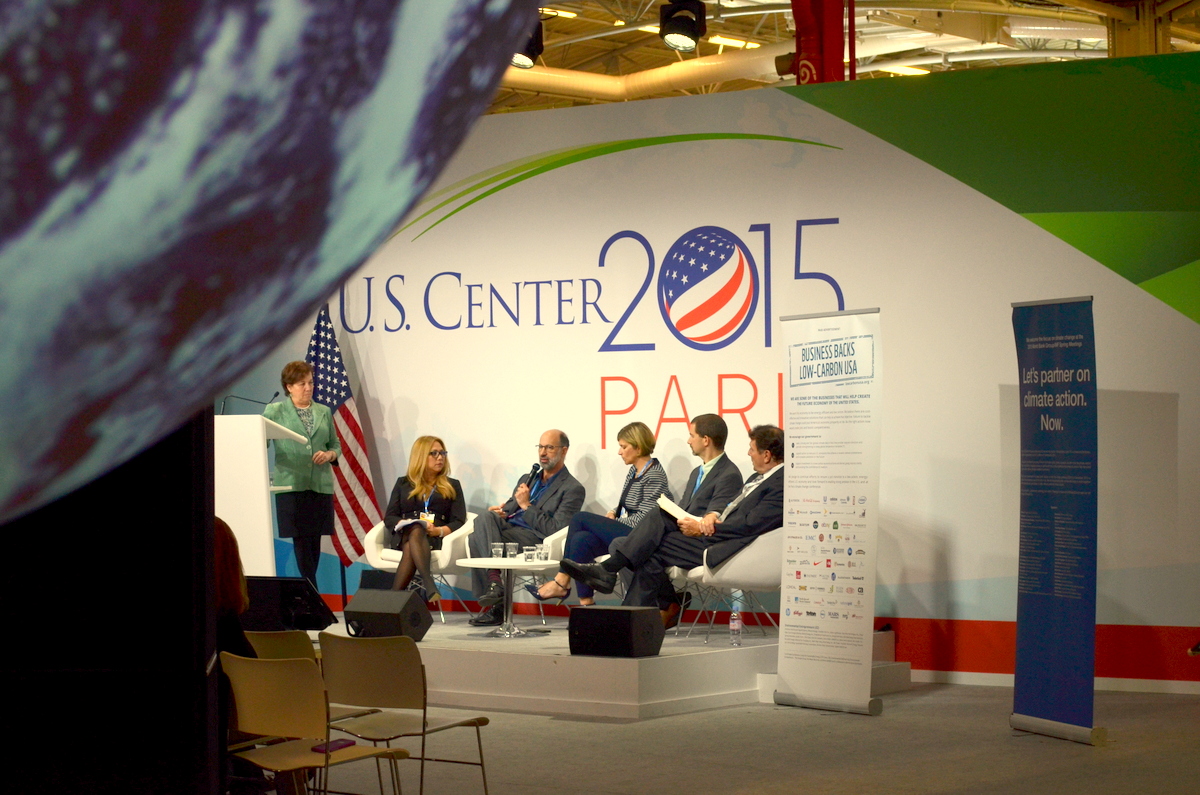
Business panel discussion at the US Pavilion. Photo by Justin Catanoso

Business panel discussion at the US Pavilion. Photo by Justin Catanoso

Triad Business Journal, where I was executive editor from 1998 to 2011, posted my first story from Paris and COP21. The story is here.

Here’s an excerpt:  The business leaders’ message was consistent and clear: Climate change in the form of drought, more frequent and erratic storms of greater intensity, and rising sea levels, is costing them millions, disrupting their supply chains and damaging their investments. Mostly, though, they each stressed the economic opportunities lost in not transitioning more aggressively to renewable energy sources.

UN’s Ban Ki-moon: “This is no Plan B because there is no planet B”

See original image

This Monday afternoon, Dec. 7, 2016, on the first day of the final week of the 21st UN climate summit, I slipped into a press conference just as Ban Ki-moon,  the UN general secretary, was answering a question of great interest to me — the intersection of faith and climate change. Here’s what he said:

“I am very grateful to Pope Francis for his clear moral leadership on this issue with the document he released in June (the papal encyclical Laudato Si, On Care for Our Common Home). I have spoken with him about this and greatly appreciate his efforts in support of the environment.

“It’s important to realize that climate change has nothing to do with religion. It has everything to do with humanity. We have to show some wisdom. Not just wisdom, but common sense. We have to live harmoniously with nature. Nature does not negotiate with human beings. We have to adjust to nature. That’s our only choice.

“We have to do what science tells us. Climate change is caused by human behavior. It only follows that humans have to change their behavior. As you know, we don’t hear many skeptics any longer. Even so, faith leaders have a role to play in convincing the remaining skeptics that climate change is real, and with faith leaders, we must all act and work as one.

“We have only one planet. There is no Plan B because there is no planet B.”


Gov. Jerry Brown warns COP21 crowd in Paris of “Eve of Destruction”

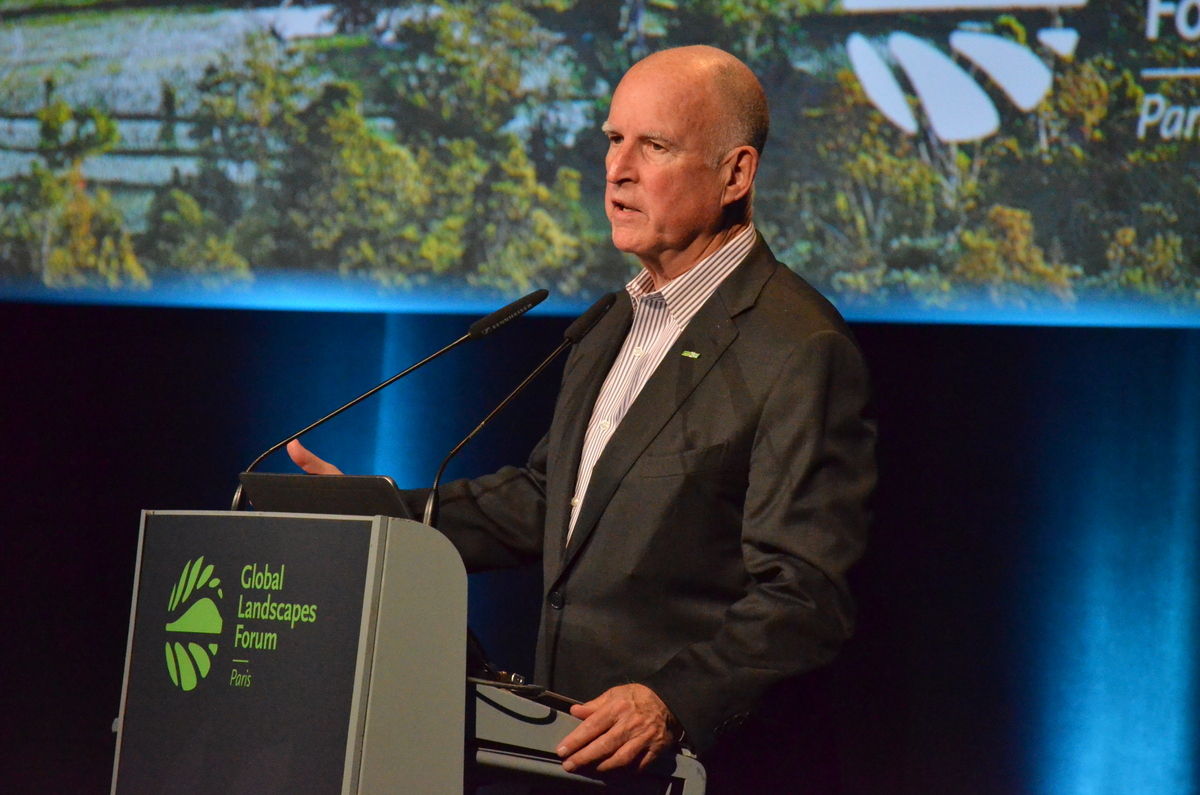
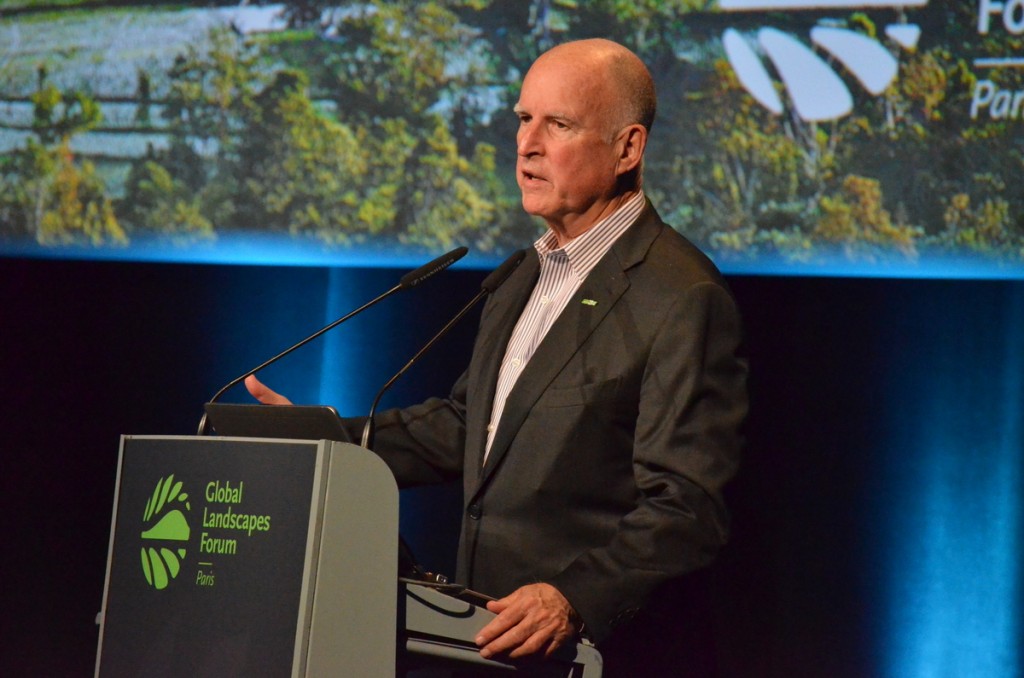
California Gov. Jerry Brown at the Global Landscape Forum, part of COP21 in Paris. Photo by Justin Catanoso

California Gov. Jerry Brown at the Global Landscape Forum, part of COP21 in Paris. Photo by Justin Catanoso

California Gov. Jerry Brown, whose distinctive voice I recognized as I entered late the packed hall in which he was speaking, was trying to remember a song from the 1960s. “I think it’s called ‘Eve of Destruction.’ Can’t remember who sang it, but I still like it. You should listen to it. It’s perfect for today.” (The song was written in 1964 by P.F. Sloan and performed by Barry McGuire, whoever the hell they were…)

Brown was a speaker today, Dec. 6, 2015, at the Global Landscape Forum, a side event of panel discussions and speeches about the importance of land use policy and forest preservation. Brown’s panel was called: “Science-policy exchange — Big ideas to connect landscapes, climate and development.”

Brown is a leftie, hippie-type who dated folk singer Linda Ronstadt in the 1970s when he was first California governor, and ran for president in 1980 as Gov. Moonbeam. He has since become the most mature, liberal, effective and realistic governor in America. Now in his 70s, he speaks his mind, and doesn’t give a darn much what people think. Why should he? When it comes to environmental protection and innovation, California leads the nation, if not the world.

“Not one thing is going to do it,” Brown told the crowd of more than 1,500, when it comes to keeping global warming under 2 degrees C by 2100. “It’s all of it together. This conference (COP21) is one of the biggest things for climate change ever. Every country is involved. Every country is pledging to do something. Let’s get that settled and then start pushing for more.

“The challenge will be relentless. But the fact that you’re here says a lot. Don’t get tired. Don’t lose heart. Don’t get excited about something else. This is it. But it’s just the beginning. It’s a lifetime challenge and task, if we really want to save the planet. And in that, I join you.”
WGHP Fox 8 TV — Talking with anchor Neill McNeil about the Paris climate summit

DSC_0169

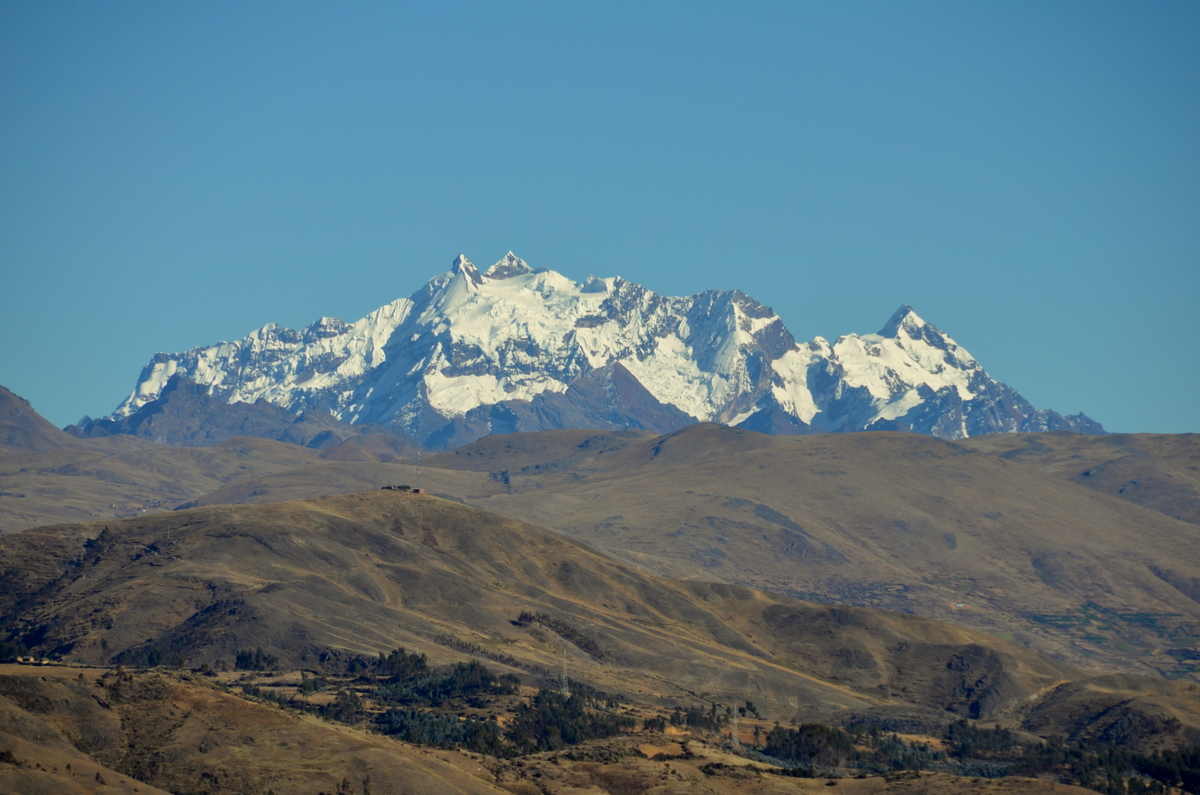
One third of the Peruvian population — 9 million people — live in Lima. Problem is, Lima is a desert. It does not rain there. At all. Lima depends on glacier melt for the sprawling city’s drinking water. Yet those Andean glaciers have shrunk by 30 percent due to global warming. On the evening of Dec. 1, 2015, the Triad’s top news anchor invited me on WGHP-TV to talk about the UN climate summit in Paris, I was more than happy to do so.

News & Observer: UN climate change summit could bring first progress in years

On the eve of the 21st United Nations climate summit in Paris, France — a city in which I will arrive on Friday morning, Dec. 4, the News & Observer of Raleigh runs on its Sunday front page a story of mine regarding what’s at stake for the talks and what obstacles lie ahead to meet carbon emissions target to slow the rate of global warming.

The story also appeared in the Charlotte Observer, and likely other McClatchy newspapers in the chain. John Knox, a Wake Forest law professor and special UN representative on climate change and human rights, was a key source.

Wake Forest University law professor John Knox is the United Nation’s special representative on climate change and human rights. He will be in Paris this week for the international climate summit.

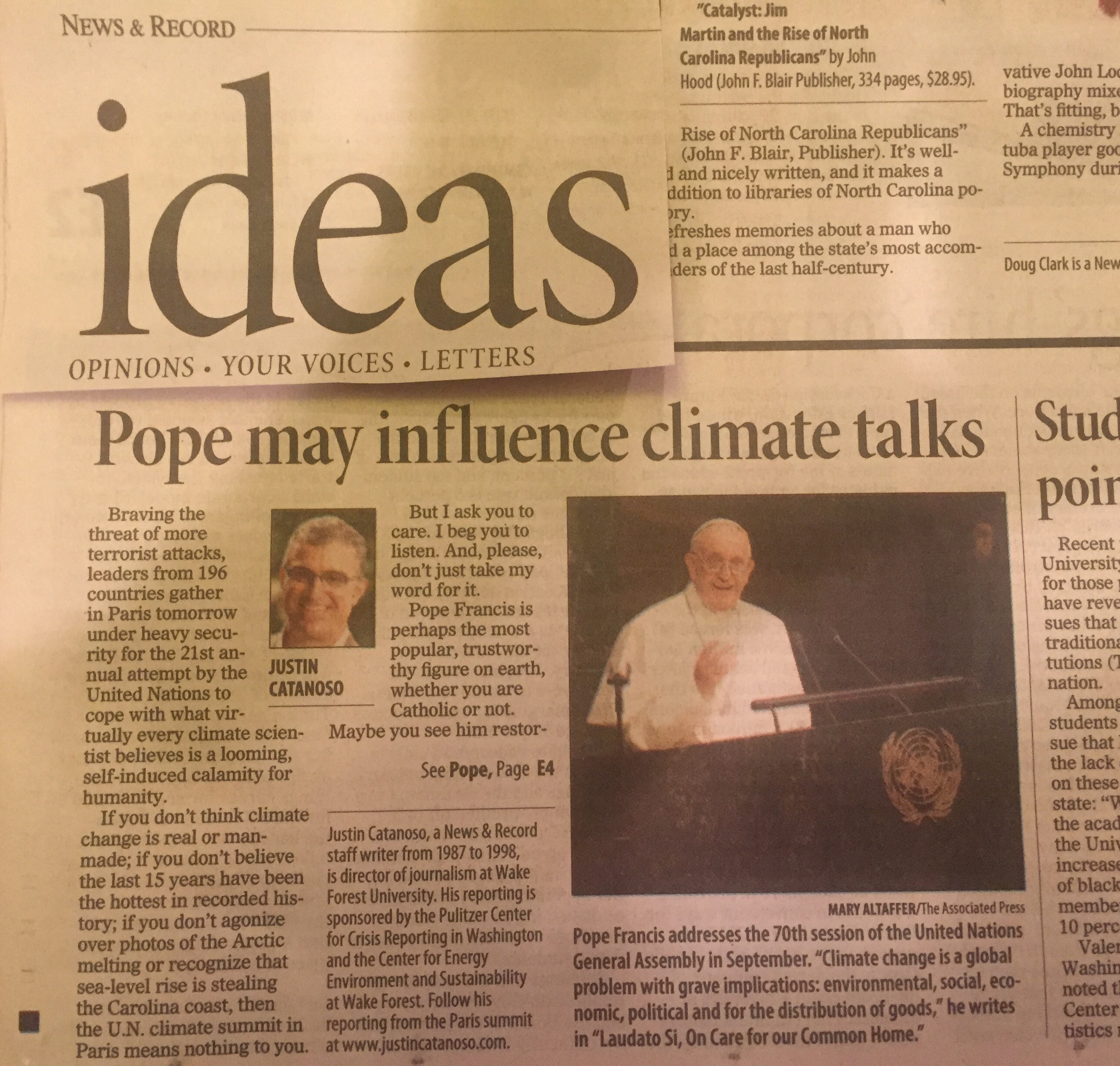
News & Record: Commentary — Pope may influence climate talks

N&R opinion page photo LRG

I was a staff writer for the News & Record of Greensboro from April 1987 to April 1998 — 11 years. When I decided to take the job as executive editor of a new weekly newspaper in town, The Business Journal, I was asked to leave the paper immediately, even though I was prepared to give at least four weeks notice.  Today, Nov. 29, 2015, I have my first byline in my old daily newspaper in 17 years. It’s a commentary on the UN climate summit in Paris, France, which I will cover for mongabay.com.

Mongabay.com: Catholic bishops ask for binding, transformative COP21 climate treaty

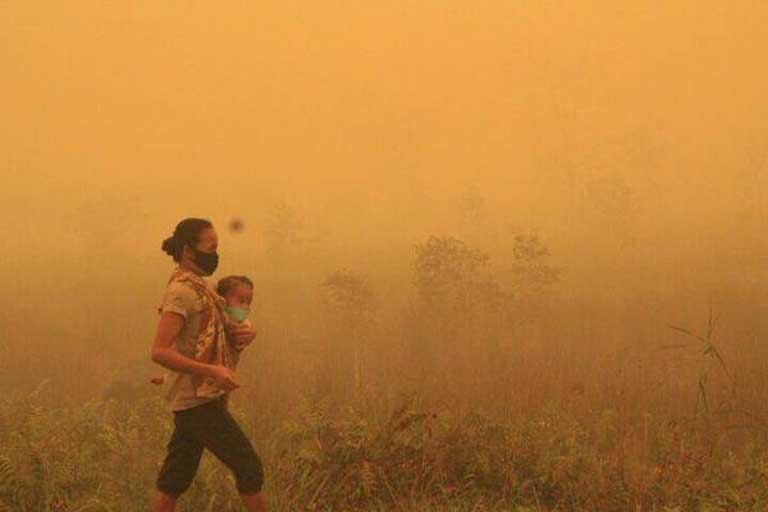
indonesia-woman-and-childIndonesia on fire, October 16, 2015. An image posted on Twitter purporting to show the smoke-choked city of Palangkaraya. Damages from the record wildfires has already topped US $30 billion; acrid smoke has sickened half a million people. “This is my urgent call… Guarantee the future of Oceania. Change society to a low-carbon lifestyle,” said Monsignor John Ribat, President of the Federation of Catholic Bishops’ Conferences of Oceania and the Archbishop of Port Moresby, Papua New Guinea.

Glenn Scherer, my talented editor at mongabay.com found this photo to run with a breaking news story I wrote for the web site on Oct. 27, 2015. Jim Yardley, my friend and New York Times bureau chief in Rome, let me know about an important Vatican press conference that would be streamed live on Oct. 26 and that I should “cover” from my office at Wake Forest.  Amazingly, I did. I split my screen with the Vatican’s YouTube channel on one half, and a Word doc for notes on the other. As Glenn’s cutline points out, the bishops call for a binding, transformative agreement at COP21 in Paris in December is critical.  I made my 6 p.m. deadline, Gleen edited it expertly and filled it in with amazing photos. The story is here.

On Nov. 5, 2015, my 56th birthday, I received this gift from the United Nation’s Council on Climate Change (UNFCCC):

“You have been successfully registered for the UNFCCC session Twentyfirst Session of the Conference of the Parties (COP21) and the eleventh Session of the Conference of the Parties serving as the meeting of the Parties to the Kyoto Protocol (CMP11).”

Sunday News & Observer: Pope gets pushback on environment

"The life of the plant is more important than anything the pope says." Photo by Jason Houstin

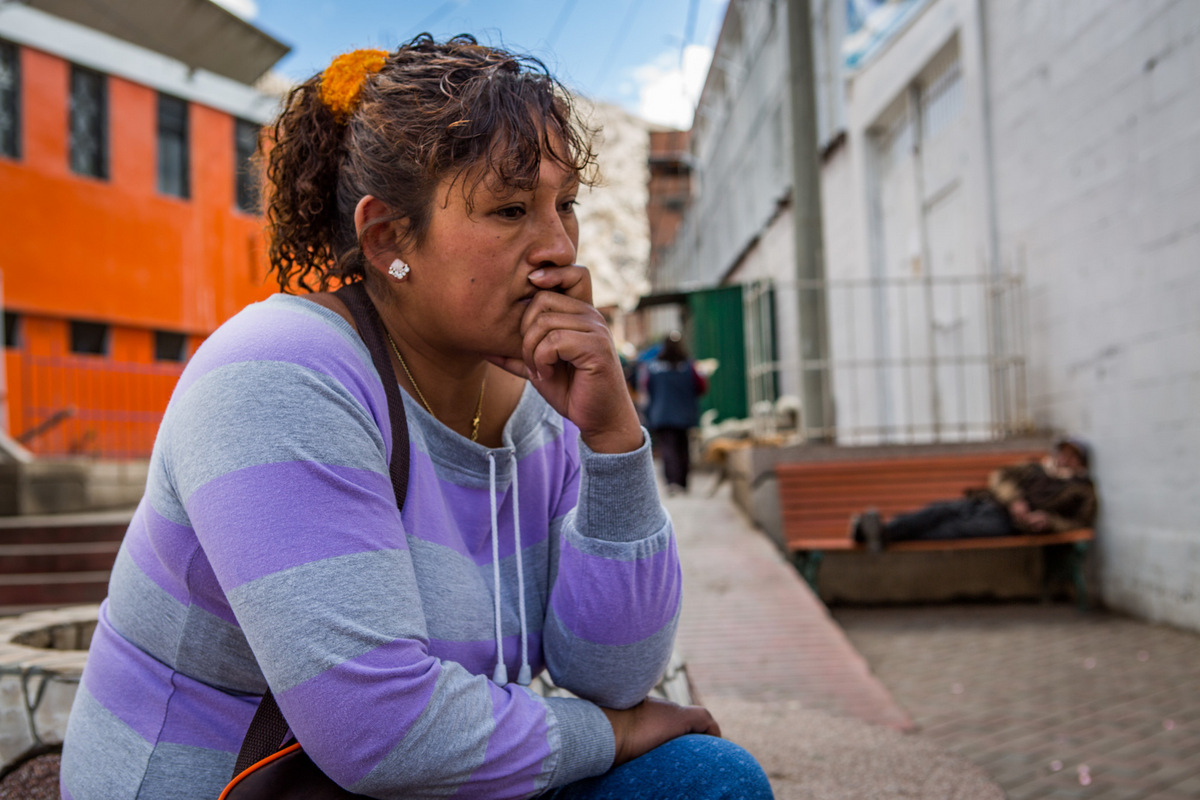
Emel Salazar in La Oroya, Peru: “The life of the plant is more important than anything the pope says.” Photo by Jason Houston

Every Pulitzer Center journalist must ensure that his or her work will be published or broadcast before a grant is considered. That’s the model. They pay expenses so that your work can fill the gaps of news organizations that want foreign reporting, but no longer have staff abroad. When my Pulitzer turn came around around again last spring, I called an editor I’ve long admired but never had the opportunity to work for: John Drescher of the New & Observer in Raleigh, N.C. After explaining my project, he readily agreed to take one of my stories. I was thrilled.

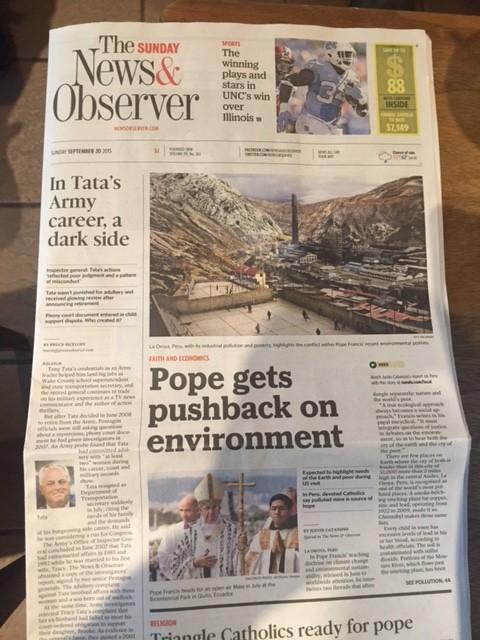
So on Sept. 20, 2015, I had my first page 1 story in a Sunday daily newspaper since I left the News & Record in Greensboro in May 1998. That’s a long time before Sunday fronts, but given that the N&O practically cleared page 1 for me and published all 1,900 words I wrote, plus several photos, it was worth the wait. It’s funny, but in buying papers in Chapel Hill, I felt the same thrill I did when I was a kid, seeing my first byline in print.

Front page, The Sunday News & Observer, Sept. 20, 2015. Photo by Justin Catanoso

Front page, The Sunday News & Observer, Sept. 20, 2015. Photo by Justin Catanoso

WFDD: Pope’s U.S. Visit Comes As He Calls For Climate Change Action

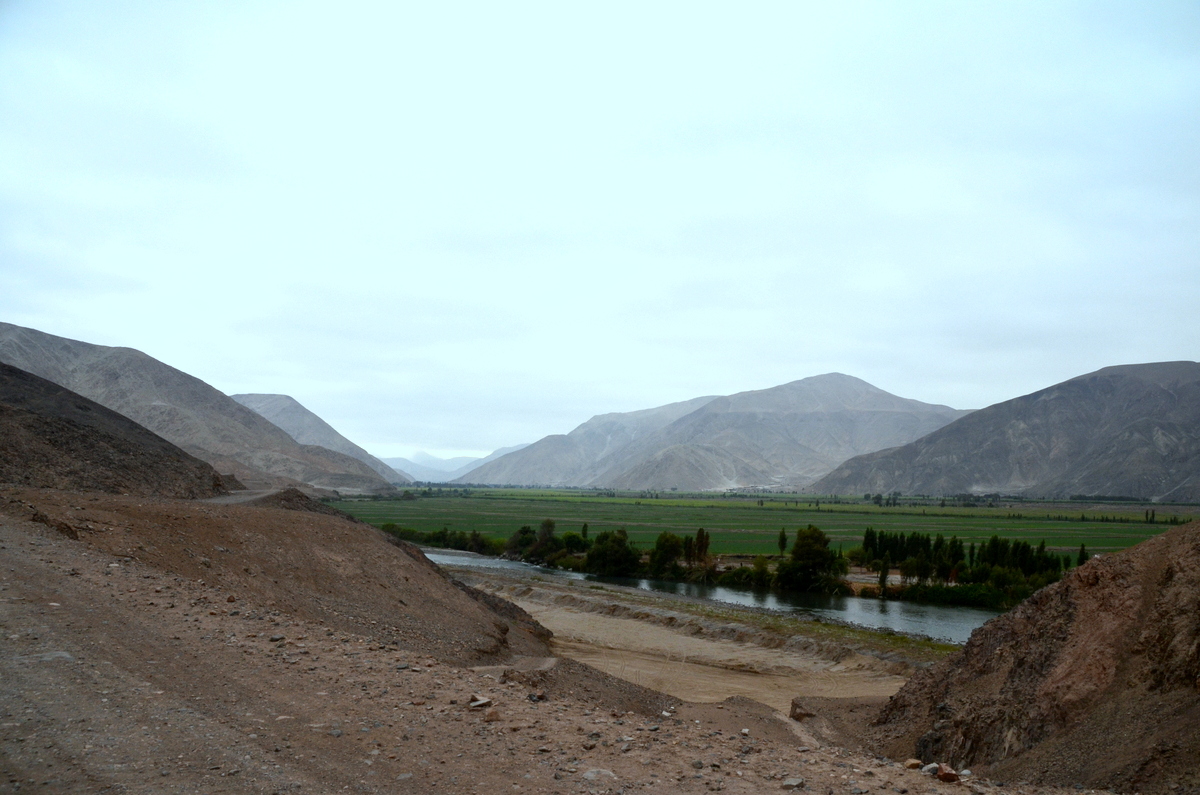
This farm valley in southern Peru is threated by a proposed copper mine. Photo by Justin Catanoso

This farm valley in southern Peru is threated by a proposed copper mine. Photo by Justin Catanoso

Emily McCord, the news director at WFDD, has had a huge interest in my climate change reporting since she joined the station a year ago last summer. I am grateful for that. Today, Sept. 21, 2015, she broadcasts my first radio report based on my Pope-and-Peru reporting.

Global Pulse Magazine: Pope Francis’ Encylical and Three Priests of Peru

This Peruvian priest in Cocachacra, home to the most contentious environment battle in Peru, is determined to remain neutral -- unless instructed otherwise. Photo by Justin Catanoso

This Peruvian priest in Cocachacra, home to the most contentious environment battle in Peru, is determined to remain neutral — unless instructed otherwise. Photo by Justin Catanoso

I met Robert Mickens in Rome in May through my good friend, Rome-based freelance journalist Eric J. Lyman. Mickens happens to be a leading expert on the Vatican and the guy who explained how I could get credentials to cover the release of the papal encyclical.

He was also interested in my reporting from Peru, and published my second story that focuses on three Peruvian priests in three parts of the country with three different perspectives on the environmental document. Mickens is the editor of GlobalPulseMagazine.com, which covers the Vatican and all things Catholic. The link to the story is here.