Tag Archives: Climate change

Mongabay exclusive — Whistleblower: Enviva claim of ‘being good for the planet… all nonsense’

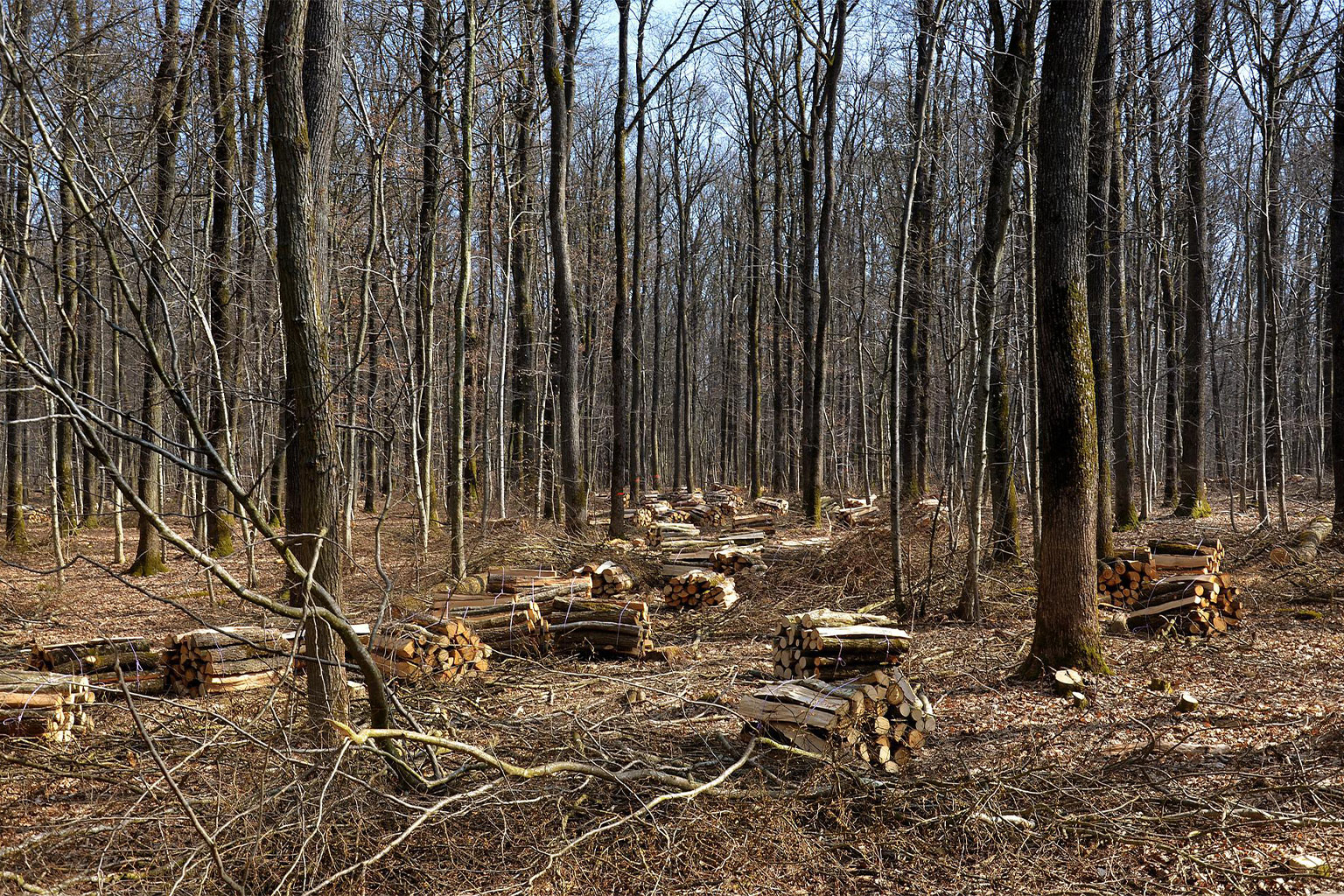
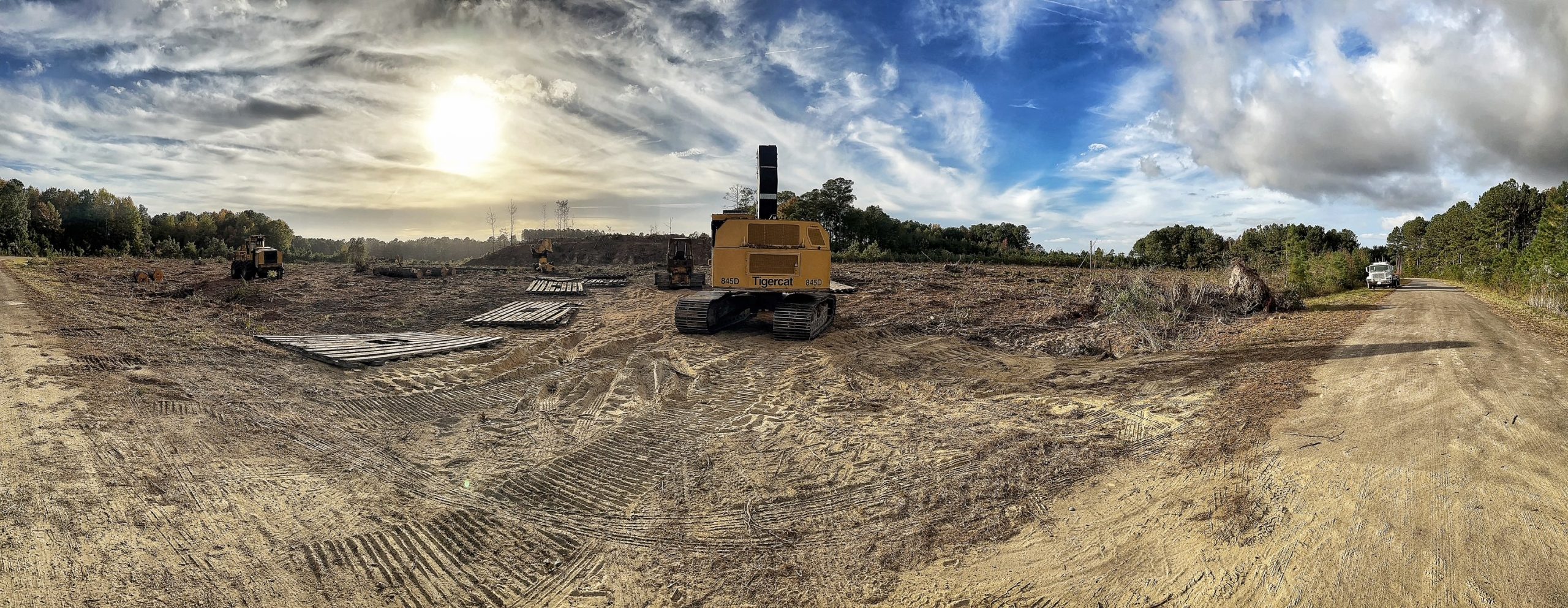
Two weeks before this photo was taken in Edenton, North Carolina, a small town in the state’s coastal plain, this 52-acre site was a densely wooded, biodiverse forest. It was clear cut in part to feed Enviva’s nonstop, bottomless demand for trees for wood pellets in the US Southeast. Enviva says this is a climate-friendly solution to energy production; the world’s top forest ecologists argue otherwise.

This story — the first of its kind ever written about the global biomass industry — started with an email in spring 2022 forwarded to me through the Mongabay web site. A well-placed source at Enviva, the world’s largest producer of wood pellets for industral-scale energy, wanted to talk. “I’m sick of the lies,” he wrote.

Over the course of the next several months, the source and I spoke many times at length. He shared with me his unique and powerful insider view of a company that claims one set of principles and priorities to the public, to regulators and to investors when it comes to wood harvests, and by all appearances, largely does the opposite.

To verify much of what this source was telling me over the summer and fall, I traveled to Edenton in eastern North Carolina in November 2022 with my friend and colleague Bobby Amoroso to observe a clear cut taking place on 52 acres of city-owned land. There I witnessed illustrations of Enviva’s apparent double talk about sustainable wood harvesting.

With the expert production work of Sandy Watt in London, we produced this YouTube video to summarize and complement my exclusive report for Mongabay.

The reporting for this story was extensive. It was also full, fair and thorough. I spent nearly 30 minutes on the phone with an Enviva communications staffer and explained to her, in detail, the story I was preparing and the reporting I had completed. Enviva chose to respond in writing. But I went further. I researched Enviva’s web site to show the message it puts out to the public. I interviewed an independent forester who believes, on balance, that Enviva is replacing demand for wood in eastern North Carolina, not increasing demand. I ignored allegations made against the company that I could not adequately verify to my own professionals standards. And I also made compelling use of a new study by the Southern Environmental Law Center that for the first time quantifies Enviva’s growing impact on forest cover within the wide harvest area of three wood-pellet mills in eastern NC and southern Virginia.

Why is this story important? Intact forests are the best and most effective planetary means we have of slowing the rate of global warming and mitigating the impact of climate change. The second-most important thing we can do is reduce carbon emissions from energy production. Science shows that the global biomass industry undermines both of these vital goals, and it will only get worse as pellet demand continues to grow in the UK, EU and Asia.

If you are new to the issue of biomass for energy and the controversy that has surrounded this growing industry for a decade, I encourage you to read this story and watch the video. A special thanks to Gizmodo for reporting on my story and Yahoo News for spreading it farther and wider. And thanks also to the Pulitzer Center in Washington, D.C., which has sponsored some previous wood pellet reporting of mine, for including this story and others in its December newsletter.

Mongabay also had my story translated into German. That link is here.
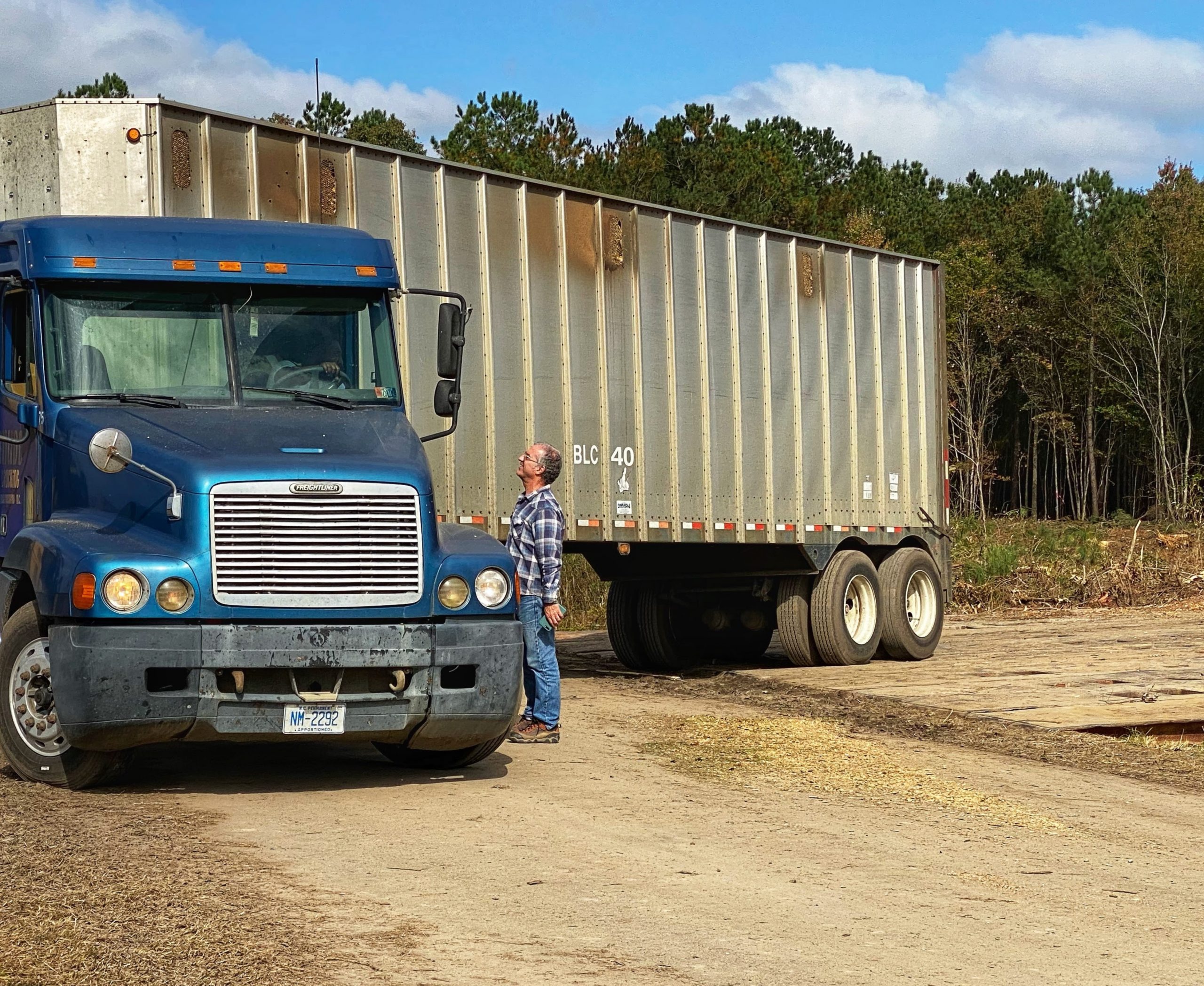
That’s me on site at the Edenton clear cut. The truck driver confirmed to me that he is carrying 40 tons of chipped trees to Enviva’s wood-pellet mill in Ahoskie, 37 miles away. He told me he makes three or four round trips a day. When I arrived in Ahoskie, trucks with 40 tons of wood chips arrived every five minutes — as many as 60 a day, every day, every week, every year. Enviva announced it will double its US pellet production from 6.2 million metric tons annually to 13 millions metric tons within five years. The $1 billion company has 10 plants in the Southeast.
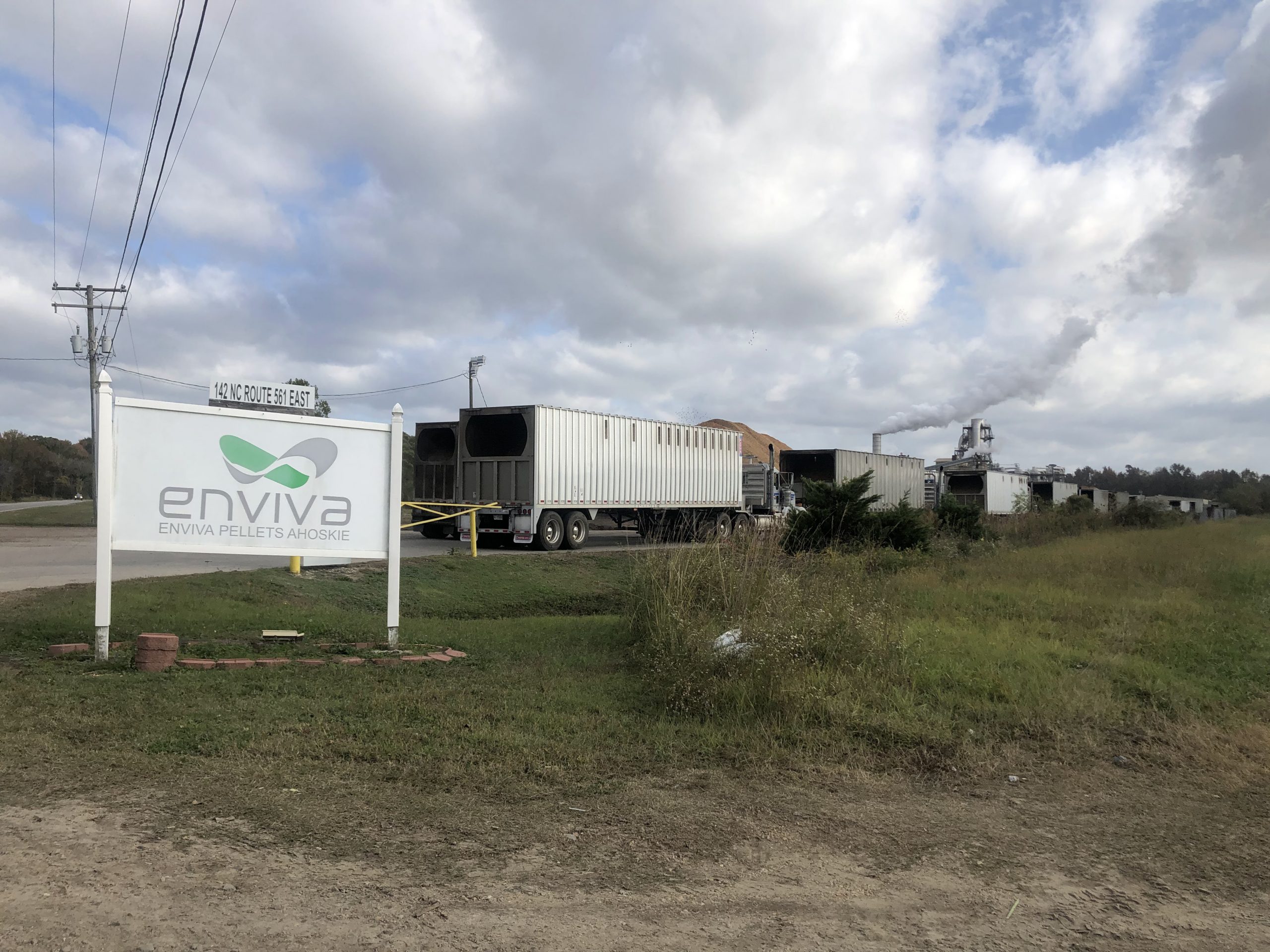
Enviva’s pellet plant in Ahoskie, North Carolina, on the day I visited. Each truck is carrying 40 tons of chipped wood that used to be trees from intact forests within 50 miles of the plant.

Mongabay: As EU finalizes renewable energy plan, forest advocates condemn biomass

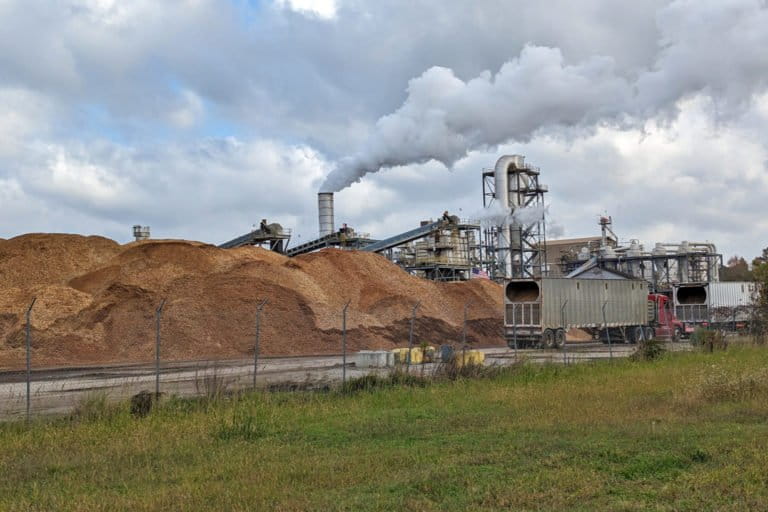
Wood chips piled in mounds more than 6 meters (20 feet) high cover the lot of an Enviva wood pellet plant in Ahoskie, North Carolina. Enviva claims it uses wood waste and doesn’t use large whole trees in the making of its wood pellets and that it only accepts wood from sites that will be replanted with trees — greenwashing that was discounted this week by a whistleblower who worked for Enviva and also confirmed by a Mongabay onsite investigation. Image by Justin Catanoso for Mongabay.

As I was preparing my exclusive whistleblower story, a commentary was released in the journal Nature that sought to weigh in on the late-stage negotiations in the European Union on its Renewable Energy Directive (RED) as it applied to biomass harvest and burning. The headline pretty much summed up the message: EU climate plan boosts bioenergy but sacrifices carbon storage storage and biodiversity.

I interviewed the lead author, Tim Searchinger of Princeton, sought comments from sources in The Netherlands and Germany regarding the state of the negotiations, got one German member of parliament to answer a few questions without attribution, and layered in context regarding European politics and bioenergy industry lobbying.

The result: this story that updates readers on the state of RED negotiations and the latest scientific arguments for limiting biomass harvest and burning, and eliminating billions in subsidies. A reference to my whistleblower story fit into the story as well.

Mongabay: New study identifies mature forests on U.S. federal lands ripe for protection

Redwood trees in California. Iconic species including redwoods and giant sequoias are fairly well protected. But the new study calls for a wide range of mature and old-growth forests on federal lands to become fully protected. Image by Rhett A. Butler / Mongabay.

Forest ecologist Dominick DellaSala of Wild-Heritage in Oregon has been eager to produce high-quality, verifiable maps of remaining intact, mature and old-growth forests across the continental United States. He and I have been discussing the potential for such mapping to help create what he and colleague Bev Law of Oregon State call a Strategic Carbon Reserve, akin the the Strategic Petroleum Reserve that presidents call upon when gas prices spike or OPEC suppliers manipulate global oil supplies.

The carbon reserve would act as a protected carbon sink in the US that would remain intact, biodiverse and capable of continuing — and even expanding over time — its capacity to sequester greenhouse gases to help slow the rate of global warming. This story here describes the outcome of a new study (October 2022) in which DellaSala teamed with a group of forest ecologists to produce the first ever coast-to-coast mapping of such valuable, vulnerable forests.

President Biden in April 2022 requested similar mapping from his departments of Interior and Agriculture for the purpose to protecting more forests on federal land to help him meet his Paris Agreement GHG-reduction goals by 2030. DellaSala’s study will serve as a baseline comparison in April 2023 when the federal maps are due to make sure timber interests and forestry corporations don’t pressure the U.S. agencies to produce maps more favorable to logging than conservation.

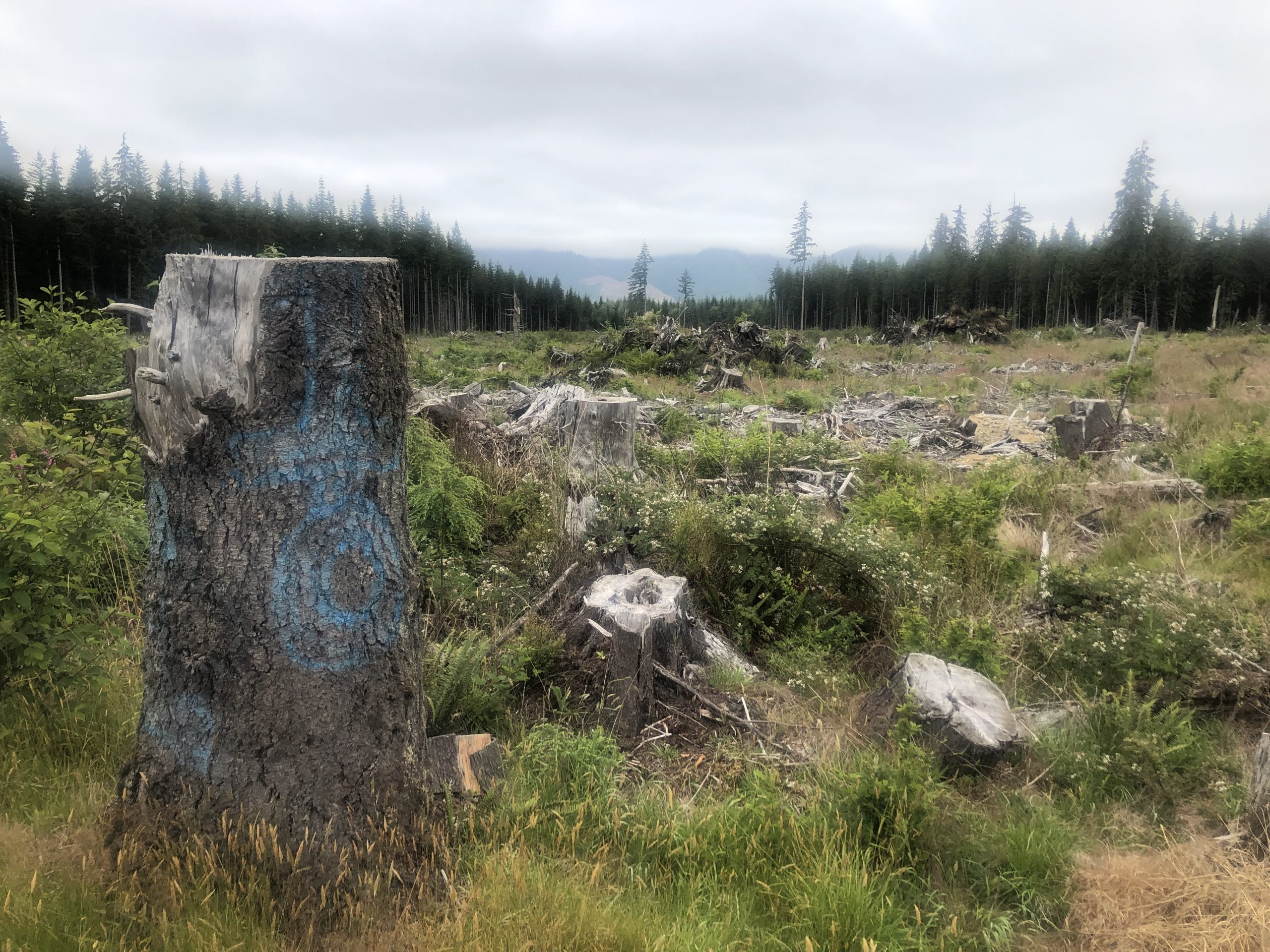
An expanse of legally clearcut forest in northwest Washington state. While national park forests are fully protected, just 24% of U.S. Forest Service and Bureau of Land Management forests are fully protected, with the rest at various levels of risk. I took this photo just outside fully protected Olympic National Park in July 2022.

Mongabay: British Columbia delays promised protections as old growth keeps falling

Torrance Coste counts the rings on a fallen old-growth cedar
Torrance Coste counts the rings on a fallen old-growth cedar in the Upper Caycuse Valley. He estimated the age of the harvested tree at 500 years or more. Image by Justin Catanoso.

In summer of 2021, during a trip to the Pacific Northwest, I had hoped to continue my coverage of British Columbia’s at-risk old growth forests. But Covid-19 restrictions kept me from entering Canada. In July 2022, with the border re-opened, I was able to report this story from the field in Vancouver Island’s wooded and extensively harvested remote outback.

What I observed was both staggering and disheartening — large blocks of old-growth forests that should have been protected from logging, given a policy promise in 2020 by BC’s majority party, were being clearcut throughout southern Vancouver Island. Logging rushed to take down ancient giants while they still could. Torrance Coste, a BC forest campaigner, was my tour guide that day, taking me to settings of environmental degradation and decimation that few BC residents, let alone legislators, ever seen. They should. Torrance is also seen in a short video embedded in the story in which he explains the difference between native forests designed by nature and monoculture tree farms planted by logging companies.

The story is thorough and nuanced with politics, environmental science and the treatment of Indigenous peoples overlapping; I appreciate my editor Glenn Scherer giving me the space I needed to tell the full story. As a key source told me in the BC capital of Victoria:

“Certain politicians say, ‘Canada is just 1% of global emissions; it doesn’t matter what we do. But if we protect our at-risk old growth, we can be 10% of the global solution. Why don’t we want to be the beacon of what’s possible? Wouldn’t that be nice?”

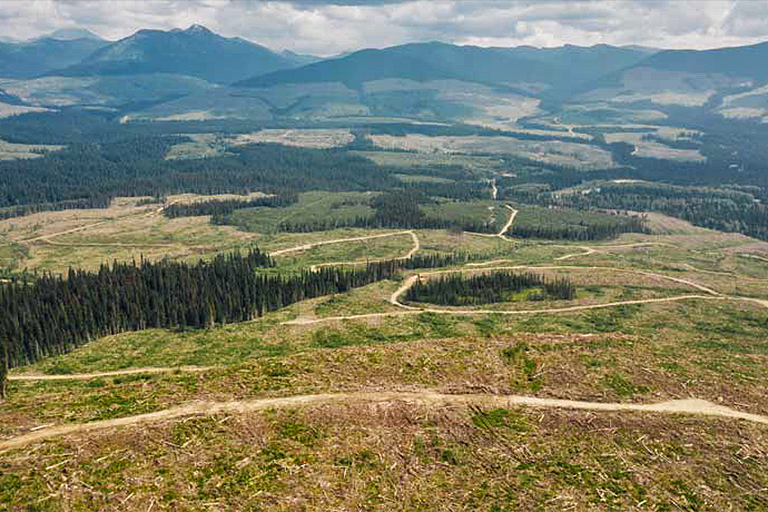
Clearcut logging in the Anzac Valley
Clearcut logging in the Anzac Valley, part of the boreal rainforest near Prince George, British Columbia. Image by Taylor Roades courtesy of Stand.earth.

Mongabay: EU votes to keep woody biomass as renewable energy, ignores climate risk

In addition to forest loss, wood pelletization uses significant energy in the transport of logs harvested in the U.S., Canada and elsewhere, in the processing of wood to make the pellets, and for transportation overseas to the EU where the pellets are burned. Image by #ODF at Visualhunt.com

This story follows up on a one I wrote last spring (2022) regarding the negotiations around possible revisions to the European Union’s Renewable Energy Directive (RED), which is evaluated every three years. Of peak interest has been whether members of parliament would change their view toward the continent’s use of woody biomass for heat and energy and its impact on global forests.

Biomass accounts for more than 60 percent of the EU’s renewable energy portfolio — but legions of scientists continue to argue there is nothing renewable about burning biomass, at least at it compares to zero-carbon wind and solar.

While parliamentary committees for the first time recommended changes in subsidies for woody biomass and increased protections for Europe’s forests — which provide the bulk of the EU’s pellet production — the outcome appears far different. Yes, it calls for phasing down of subsidies, estimated at $13 billion annually. It also calls for protection of natural forests, saying only lumber residue and damaged trees can be used for pellets. But forests advocates explained to me that the amendments that were approved are vague enough to not change EU woody biomass consumption — or the emissions they produce — at least for the next three years.

This view was essentially supported by a statement by US-based Enviva, the world’s largest pellet maker, that hailed the RED amendments as a victory for the bioenergy industry.

Here’s the big thing: an amendment that would declassify woody biomass as a renewable energy source, on par with wind and solar (a well-reported error that began with the 1997 Kyoto Protocol) was rejected. This, too, was cheered by the bioenergy industry.

Mongabay: Missing the emissions for the trees: Biomass burning booms in East Asia

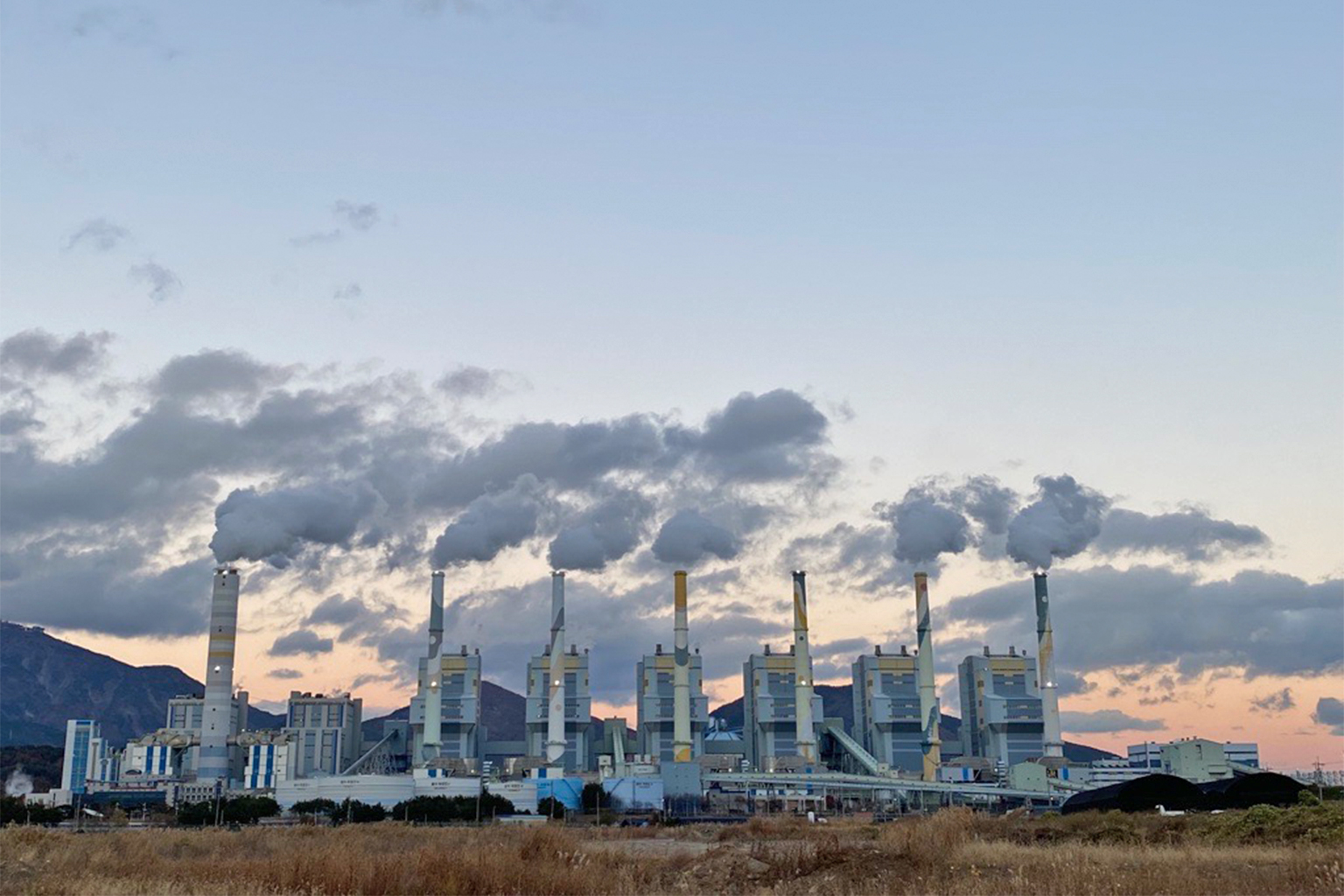
The Hadong power plant in South Korea co-fires coal with woody biomass, allowing it to claim it is reducing emissions under the UN loophole.
The Hadong power plant in South Korea co-fires coal with woody biomass, allowing it to claim it is reducing emissions under a carbon accounting loophole. Photo courtesy of Solutions for Our Climate.

This story here began about a year ago with an email from Roger Smith, a forest advocate for the NGO Mighty Earth in Tokyo, Japan. He had been following my biomass coverage focusing on the United Kingdom, Europe, Southeastern United States and British Columbia, and wanted me to know that biomass energy was growing in Japan. Would I write about it?

The short answer was yes. Roger and I spoke for more than an hour not long after he reached out. I intended to do the story during COP26 in Glasgow, Scotland, in November. But other stories piled up, time flew by, and even though I met the chief of staff of Japan’s energy minister, who promised to arrange an interview — after the climate summit — it didn’t happen. Fortunately, an American freelance journalist in Japan, Annelise Gisebert, pitched a biomass story to Mongabay, and my editor Glenn Scherer saw an opportunity for us work together.

It took more than a month of reporting, worked in around classes and grading, and a 13-hour time difference for Annelise and me to arrange interviews and talk about our reporting. But we finally compiled the information we needed for the first in-depth, Asia-focused stories on biomass that have been written at Mongabay. Annelise’s story, linked here, ran a week after mine.

Essentially, I wrote about the demand side for biomass in Japan and South Korea, while Annelise focused on where all the additional wood is coming from to meet Asian demand. What’s clear is that as both countries look to generate more energy from wood, more trees from intact forests will fall around the world at the very time we can least afford to lose their ecosystem services during this escalating climate crisis.

My story was translated into Chinese. Here’s the Chinese language link.

Forest advocates have been arguing for years that burning wood for energy on an industrial scale poses a host of environmental threats while undermining climate action.
Forest advocates have been arguing for years that burning wood for energy on an industrial scale poses a host of environmental threats while undermining climate action; these include increased deforestation, elevated carbon emissions, loss of carbon sequestration capacity, and adverse biodiversity impacts. Image via Max Pixel.

Mongabay: Activists vow to take EU to court to fight its forest biomass policies

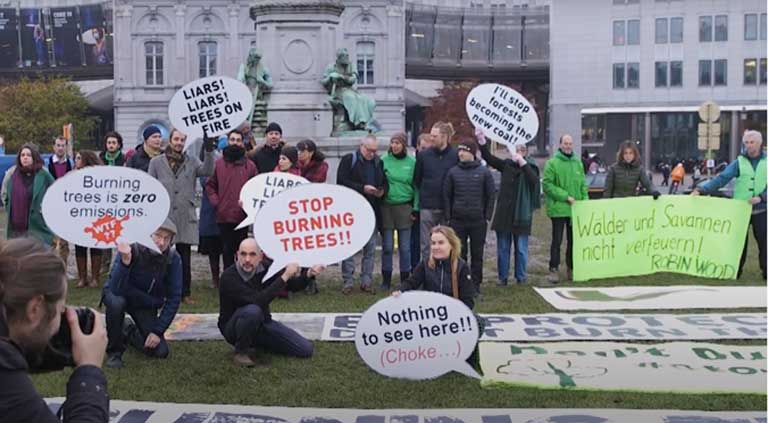
In mid-November, at the conclusion of the UN climate summit in Glasgow, Scotland, forest advocates from across Europe gathered in Brussels outside the EU headquarters to protest the increasing use of wood pellets for energy instead of zero-carbon renewables such as wind and solar power. Photo courtesy of Daniel Djamo.

Since 2018, when I first began writing stories related to biomass, I’ve covered the issue and story from a variety of angles. Most have focused on efforts by forest advocates, ecologists and climate scientists to use a growing stack of peer-reviewed science to impress upon policymakers, especially in the European Union and United Kingdom, that replacing coal with wood — in the form of pellets, chips or other forms of biomass — is not a viable climate solution and is actually driving up carbon emissions — the very thing that needs to be reversed to slow the rate of global warming. Some stories have simply focused on the unparalleled success of the wood pellet industry, its accelerating growth and profits, and the fact that it makes up 60 percent of “renewable” energy in Europe, not zero-carbon wind, solar or nuclear.

The forest advocates are losing this battle — badly. It’s not even close. State subsidies to burn wood instead of coal reach into the billions. Profits are growing. New markets are ramping up in Asia. And intact forests — the first line of defense in reducing greenhouse gases in the atmosphere — are falling in greater acreage for wood pellets in the Southeastern United States, British Columbia, Eastern Europe and soon Vietnam.

This story, posted March 2022, follows up on a story I wrote from Glasgow in November 2021 at COP26: the new front in climate action is litigation. Forest advocates, with a lawsuit prepared, are now hoping for access to the European Court in Luxembourg as a way of altering EU policy toward biomass to reduce its usage and provide more protection for the world’s forests. My story is reported from a variety of angles which explain both the opportunities and obstacles to this approach, and a new study that breaks new ground on the long-term impact of the growing demand for wood pellets for energy and heat.

A collage of studies over the years regarding biomass and its impacts ¬– including the study cited in this Mongabay story. Image by Justin Catanoso.

Mongabay: Hope old and new – COP26 focused on two largely unsung climate solutions

At the Climate Action Center at the Scottish Event Center in Glasgow, the picture-worthy sign #COP26 was filled with tropical plants. Every summit, attendees make sure to have their photo taken in front of the sign (including me).

At the conclusion of every UN climate summit I’ve covered since Paris in 2015, I’ve written a story that summarizes the highlights (few) and disappointments (many) in a kind of post-COP analysis. Because of the massive global media attention COP26 drew (nearly 4,000 credentialed journalists), that story was largely written by others before I landed back in North Carolina.

Instead, with this final story from COP26, I followed an idea that came to me during my return flight home. I decided to focus on what seemed to me to be two significant positive developments from a climate summit that was declared a failure before it even started. Those two elements — one old and easily grasped, the other new and technologically futuristic — could turn out to be climate game changers in the decades ahead. That is, of course, if they receive the international support and billions in funding required to enable both to, in one case flourish, and in the other, reach proof of concept on a global scale.

Let’s be clear. The coordinated effort to save the planet by holding global temperature rise to 1.5 degrees C over pre-industrial times has virtually no chance of succeeding without these efforts I write about, in combination with accelerated efforts to decarbonize industrial economies and halt deforestation and biodiversity loss in the world’s great forests. G-20 leaders have simply wasted too many decades making problems worse for any shortcuts or easy fixes to this existential climate crisis.

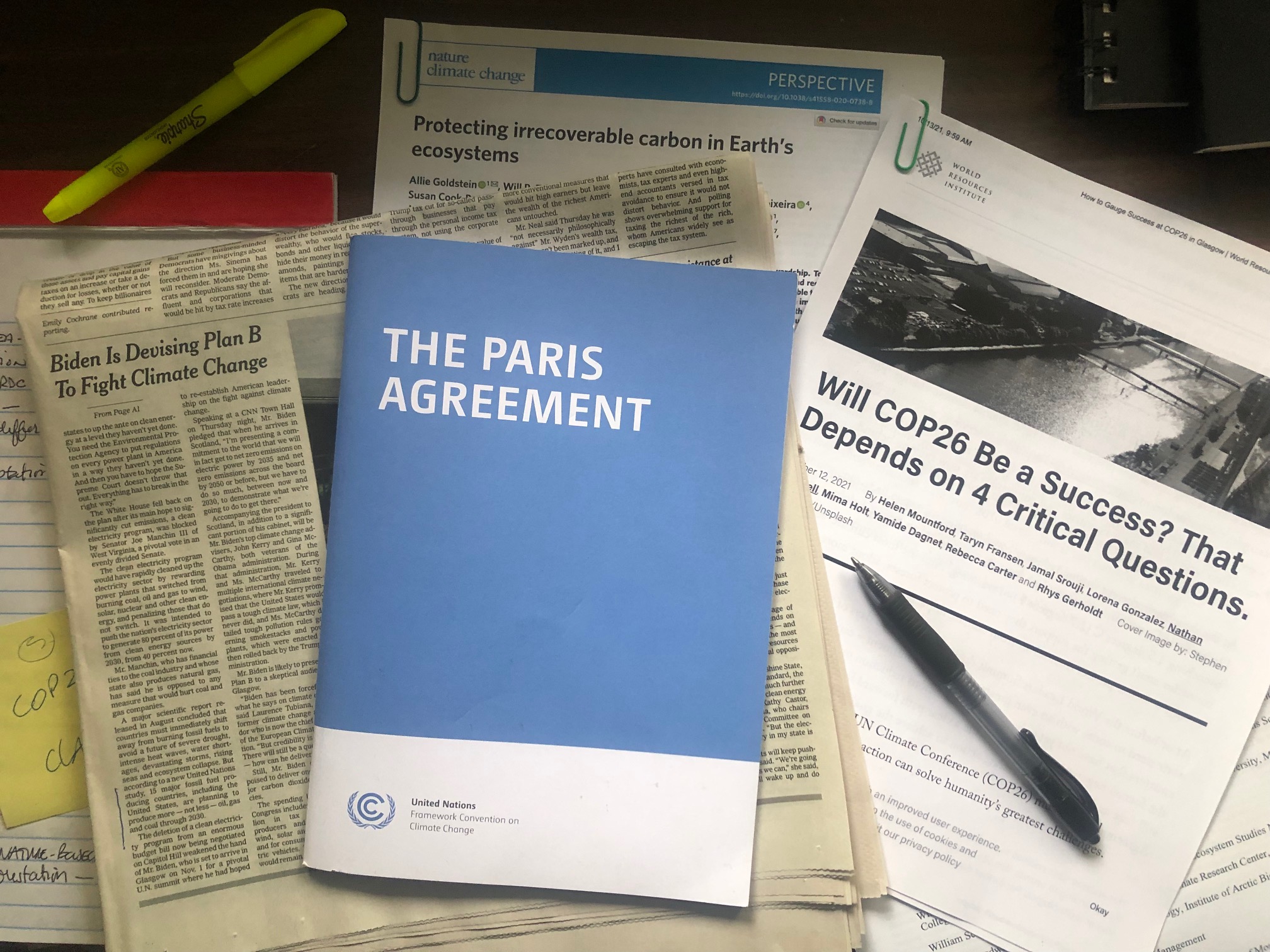
This photo collage that I took in my home office before leaving for Glasgow seems a fitting parting shot for my final story from COP26. Next year’s meeting, COP27, is planned for Cairo, Egypt.

Mongabay: ‘Standing with your feet in the water’: COP26 struggles to succeed

With Swedish climate activist Greta Thunberg leading protests both Friday and Saturday (Nov. 5-6, 2021) through the streets of central Glasgow, tens of thousands of people, mostly young people from around the world, mocked the proceedings of COP26, demanded “real” leadership, and didn’t let up even in driving wind and rain. The protests continued every day of the summit.

On Friday, November 12, I decided to take the morning off from COP26 to see a bit of Glasgow — the immense 12th-Glasgow Cathredral that reformationist John Knox changed from Catholic to Protestant, and the campus of the University of Glasgow, which I heard was the setting for Harry Potter movies. It wasn’t, but it could’ve been.

My goal on the last afternoon of official negotiations was to simply attend press conferences, track the shifting language in the latest draft of the Glasgow accords and Paris Agreement rulebook, and prepare for the climate summit wrap up I would write once I returned home to the U.S. I had no plans to write this story.

But sometimes luck intervenes and directs you to a front row seat to history. After getting into the venue, I noticed a line of people filing into the main plenary hall, called Cairn Gorm. It wasn’t long before I realized that this could be, in borrowing from Hamilton, ‘the room where it happened.’ When U.S. climate envoy John Kerry walked right in front of me on his way to his seat, and I then heard COP26 President Alok Sharma of Great Britain call the hastily called meeting of 196 nations “our collective moment in history,” I knew I had one last story to write from Glasgow.

The tension, the emotions, the high-stakes pressure, the frustration, the recognition of a race against time in rescuing the planet from the worst ravages of human-caused climate change infused grand, furious and pleading messages by delegates from every nation. What a story.

EU lead negotiator Frans Timmermans showed the assemblage a photo of his 1-year-old grandson during his comments. Together, he said, the leaders at COP26 could assure Chase’s healthy future or assure a time when he “would be in a fight with other human beings for food and water.” The plenary erupted in applause as he thundered: “This is personal! This is not political.”

Mongabay: COP26: E.U. is committed to forest biomass burning to cut fossil fuel use

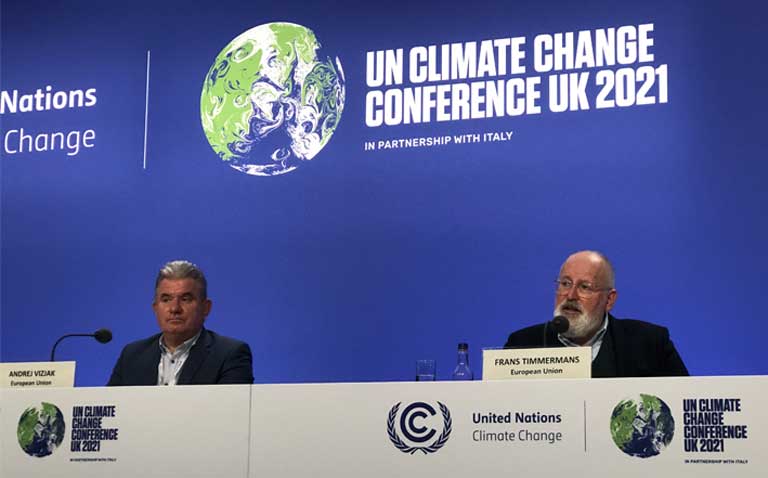
Frans Timmermans, the European Commission’s executive vice president (right), speaks during the COP26 press conference. E.U. minister Andrej Viziak of Slovenia is on left.

The last time I got to question Frans Timmermans, the executive vice president of the European Commission and easily the most influential politician in the EU, was at COP25 in Madrid, Spain, in December 2019, just weeks before the pandemic took hold. It was the last day of a dismal summit. I asked him about the future of biomass in the EU, and his answer was so surprising that it led to a story that quite literally stunned anti-biomass activists around from the US to Belgium to Australia.

In this story, my third from Glasgow, I got to question Timmermans again. This time, his answer was far more predictable, and to those same anti-biomass advocates, an enormous disappointment. I did get more than one question, though, as I asked Mr. Timmermans if he could talk further after the 30-minute EU press conference, which took place at exactly the same time former US President Barack Obama was addressing a packed plenary hall a few hundred yards away.

Aside from a range of reactions from forest defenders around the globe, I also received a detailed and thoughtful response from Christian Rakos of Vienna, Austria, president of the World Bioenergy Association. Rakos surprised me by offering an open dialogue with those who oppose everything about the industry he represents. I included it in my story and he reiterated his interest during a 90-minute meeting I had with him over Italian beer at the summit venue. Later, post-COP26, at dinner in Amsterdam with the EU’s leading biomass opponent, Fenna Swart, I mentioned to her Rakos’ interest in talking with her — even volunteering to travel to Holland to meet in person.

Swart and Rakos exchanged emails and a meeting between them is planned in Amsterdam.

Christian Rakos, president of the World Bioenergy Association, which is based in Stockholm. The EU burns an estimated 31 million metric tons of woody biomass annually for energy and heat. Rakos believes this burning of wood is far better than burning coal as well as environmentally sustainable — in the EU. His is less familiar with the industry’s impact on forests in the Southeastern U.S. and British Columbia.