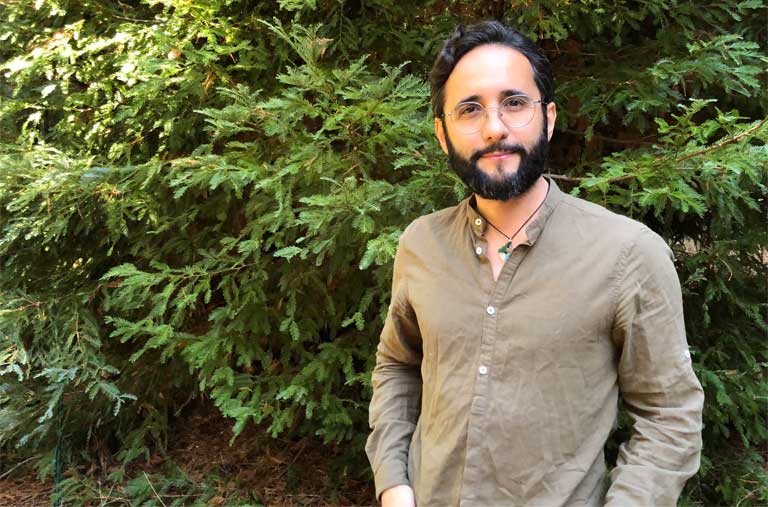
Kinari Webb was drawn to Borneo initially to study and help protect orangutans. In listening to how best to accomplish that goal, she decided that health care was the key. She entered Yale Medical School, became a physician and returned to Borneo to found Health in Harmony.
For this story, I received this pitch from a PR representative about a month into the Covid-19 pandemic. I was eager for a story that connected the essence of my reporting for Mongabay — climate change and environmental protection — with this global public health crisis. This seemed a viable idea:
“As society examines how to respond to the fallout from coronavirus, we invite you to interview Dr. Kinari Webb, founder of the international nonprofit Health In Harmony, which takes an integrated approach to human and environmental health and is one of the most effective organizations at halting deforestation in Indonesian Borneo. Dr. Webb knows that it is possible to completely rethink approaches to both health, livelihood and conservation – understanding that they are intimately intertwined.”
So I spent some time researching Kinari Webb and her NGO. I read previous stories on Mongabay about her work. I listened to her interviewed a year ago on the Mongabay podcast. Then I pitched the idea of a Q&A with this remarkable environmentalist and medical doctor to my editor, Morgan Erickson-Davis. She said yes. The PR person arranged the interview. And a few days later, I enjoyed a wide-ranging, free-flowing discussion with Webb from her home in Los Angeles. The result, during these often-depressing times of social distancing and personal isolation, is invigorating, provocative and by turns hopeful.
The four eastern cooling towers at the Drax coal-fired power station in North Yorkshire, United Kingdom. Image: Jono Brennan, CC BY-SA 2.0
This story came to me directly as a result of my coverage of the biomass-for-energy story over the past two years. Biofuelwatch, an environmental group, had organized a global group of NGOs to appeal to the world’s largest asset manager, BlackRock, to pull its 5 percent stake in the world’s largest energy-generating plant using wood pellets. Millions of tons of pellets are produced annually largely Southeastern US forests.
The underlying goal? If the world is going to dramatically reduce its use of fossil fuels, large investment companies like BlackRock need to divest hundreds of billions of dollars in oil, gas, coal and biomass, and ramp up investment in genuine zero-carbon wind and solar energy.
The company in question is one of I’ve about often; Drax, the United Kingdom’s largest energy provider. I interviewed its CEO at COP25 in Madrid, Spain, in mid-December in a fairly contentious encounter following a presentation in which no questions from the audience were allowed.
Thanks to Mongabay editor Morgan Erikson-Davis for her careful attention to detail. And thanks to my Mongabay colleague Erik Hoffner for arranging for the story to be republished here with the environmental news site Eco-Business.
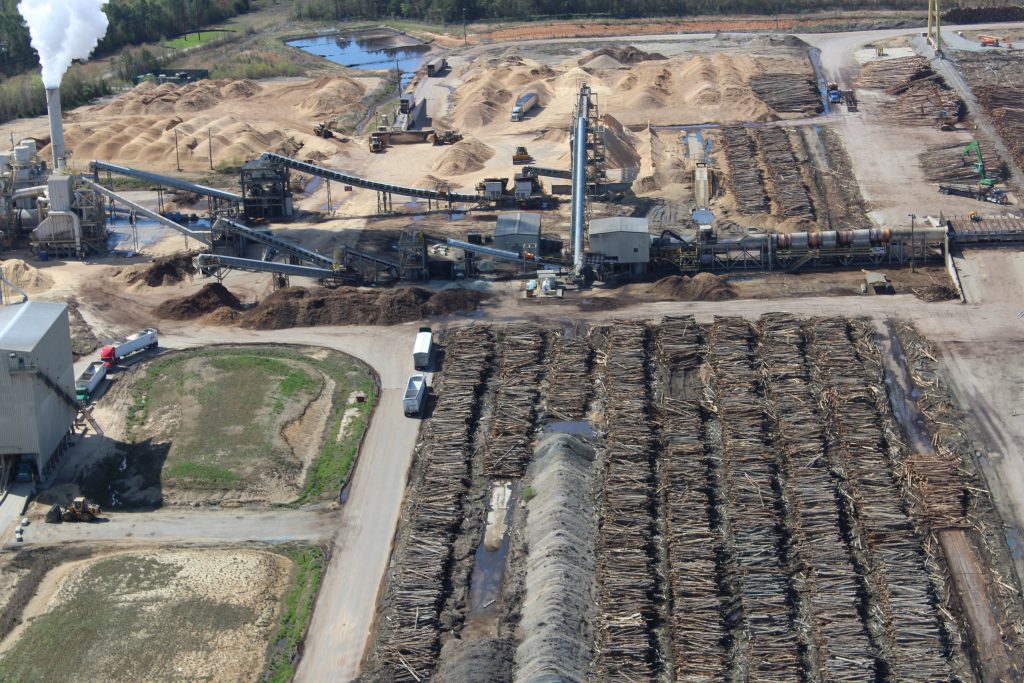
Those stacks and stacks of tree trunks collected from eastern North Carolina private land and tree farms before being turned into wood pellets bound for the UK? Most were once part of thriving forests and intact, biodiverse ecosystem.
Pope Francis meets Jose Gregorio Diaz Mirabal, a member of the Curripaco indigenous community, during a session of the Synod of Bishops for the Amazon at the Vatican, October 8, 2019. Image courtesy of CNS photo/Vatican Media.
On February 12, 2020, with a letter to “all persons of good will,” Pope Francis sought to reclaim the mantle of global environmental leadership he established in mid-2015. That’s when he the released of the first-ever papal encyclical (Catholic teaching document of the highest order) on environmental protection and climate change — Laudato Si, On Care for Our Common Home.
My story for Mongay here picks up that thread with Dear Amazon, a papal letter in response to the first-ever Vatican meeting in October 2019 to focus on a specific region of the planet — Amazonia. While topics at the so-called synod focused largely on environmental protection and the rights of the indigenous peoples who live in those jungles, the mainstream coverage of Francis’ letter focused almost solely on his decision to not allow priests to marry who agree to serve in the dramatically underserved Amazon regions spread across eight countries.
This left an opening for me to write a kind of exclusive about the pope’s environmental and social justice message, which makes up the vast majority of Dear Amazon. The story idea was pitched to me by my inimitable editor Glenn Scherer. I was glad for the opportunity.
Pope Francis at the opening Mass for the Amazon synod October 6, 2019. The administration of President Jair Bolsonaro was highly critical of the synod, seeing it as interference with Brazil’s internal affairs. Image by Daniel Ibanez / CNA.
Remote sensing through and artificial intelligence are keys to Pachama’s novel strategy for tracking the amount of carbon stored in forests for the purposes of augmenting the market for forest protection and carbon offsets. Photo courtesy Pachama
Here’s my storybehind a Silicon Valley startup up with enormous ambitions when it comes to climate mitigation with a global client to match its lofty goals.
In mid-January, Microsoft made an astonishing pledge: a company that now emits 16 metric tons of greenhouse gases annually would become carbon negative by 2030, and by 2050, zero out all of the emissions it ever put up into the atmosphere since the company was founded by Bill Gates and Paul Allen in 1975.
Much of this effort would require “negative emissions,” or pulling carbon dioxide from the atmosphere, not merely reducing its emissions from energy, transportation and infrastructure over its 12-country footprint. To do that, Microsoft will have to be heavily involved in protecting forests from deforestation to continue to act as a carbon sink, and contribute significantly to the reforestation of vast tracts of degraded land in order to pull more pollution from the sky.
My story focuses on the company, Pachama (Andean for Earth mother) that will do the high-tech aerial monitoring to verify that Microsoft’s carbon offset investments are intact and growing. It’s a critically important job if we are to get an accurate read on whether Microsoft, and others, are truly reducing their carbon footprint. I rarely get to write optimistic stories on climate mitigation, but this one certainly qualifies. It was a pleasure to interview the company’s smart and idealistic founder, Diego Saez-Gil.
Diego Saez-Gil, a native Argentinian with a graduate degree from Stanford, is a serial Silicon Valley entrepreneur. Pachama is his third company. He got the idea while touring the Peruvian Amazon with his two brothers and witnessing massive deforestation from illegal gold mining. “We all wanted to do something about it,” he said. Image courtesy of Pachama.
Wood pellet production. Photo credit: U.S. DEPARTMENT OF AGRICULTURE
The producers of The State of Things, the hour-long radio program of WUNC, invited me on the program on Jan. 14, 2020, to discuss the wood pellet series I co-authored with Saul Elbein and Richard Stradling for the News & Observer of Raleigh. Here is the link to my 10-minute discussion with host Frank Stasio. The program was broadcast from Triad Stage in Greensboro before an audience of about 50 people.
The series has drawn a lot of attention — positive and critical. Saul and I have also come under what appears to be a coordinated attack on our reporting and professional integrity by the pellet industry, including the CEO of Enviva in a commentary he wrote for the N&O. It is all validation of the accuracy and importance of our reporting on an issue central to climate change and climate mitigation. We are both proud of how the N&O editors and Pulitzer Center have stood behind us, our reporting and the fairness and accuracy of the wood pellets project. Funding from the Pulitzer Center made our reporting possible.
A worker walks past logs stacked at the Enviva plant in Northampton County, N.C. on Tuesday, Sept. 3, 2019. Enviva turns the logs into cylindrical pellets that will be burned for heat and electricity in Europe. ETHAN HYMAN EHYMAN@NEWSOBSERVER.COM
In April, Jon Sawyer, executive director of the Pulitzer Center, called me to offer an opportunity: the center had received a substantial grant to support local newspaper journalism. He wanted to know if I had a story or project in mind that would be valuable to a publication in North Carolina.
I did.
I briefly told Jon about the stories I had been writing for Mongabay for well over a year regarding the growing use of wood pellets in coal-fired energy plants in the United Kingdom and the European Union, the loophole in carbon accounting policy that allowed these enormous emissions to go uncounted (thus threatening to undermine the goal of the Paris Agreement), and to his interest, that the majority of these wood pellets were coming from North Carolina forests — millions of tons per year. Morever, the vast majority of North Carolinians, including legislators and policymakers, know nothing about the industry or its impact. Jon was interested and connected me with a Pulitzer grantee, Saul Elbein, who had published a deeply reported story for Vox.com on this issue of wood pellets.
Saul and I talked, agreed to team up, and developed a Pulitzer proposal that was readily approved; Pulitzer’s support was invaluable. I then reached out to John Dresher, the former News & Observer of Raleigh editor and acquaintance now at The Washington Post. He generously connected me to N&O managing editor Jane Elizabeth, who also, after careful consideration and plenty of questions, gave Saul and me the green light to get started.
It’s important to note that Enviva Biomass, the world’s largest maker of wood pellets with four of its eight plants in North Carolina, was not happy when it learned that Saul and I were working on this project. The multi-billion-dollar public company hired a crisis PR manager in Seattle who tried to talk Jane Elizabeth out of working with Saul and me; he tried to undermine our professional credibility based on our previous reporting on the issue, and he vowed that no one at Enviva would cooperate with us (none did). Since publication, Saul and I have been attacked by name on an industry-sponsored web site, and in an op-ed by Enviva’s CEO.
In this file photo, a logging truck loaded with freshly cut hardwoods enters the Enviva wood-pellet plant in Ahoskie, N.C. THE WASHINGTON POST JOBY WARRICK
Not surprisingly, the N&O, still one of the Southeast’s most prestigious and influential news organizations, stood by Saul and me and the story we proposed. It assigned an experienced staff writer, Richard Stradling, to work with us, as well as an exceptional editor, Dave Hendrickson, to shepherd the ambitious and exhaustive six-month, multi-part, multimedia project to publication in print and online in early January 2020. Since the personal attacks online and in print, the N&O and Pulitzer Center have stood squarely behind my and Saul’s integrity and professionalism in fairly and accurately reporting on a highly controversial story.
Below are the links to the first-ever, indepth series by an independent news organization about an industry and international carbon-accounting policy that a broad consensus of international scientists, environmentalists and public health advocates has serious concerns about in regards to aiding and abetting the accelerating global calamities of climate change:
In January 2018, Pope Francis visited Puerto Maldonado in the Peruvian Amazon, a city and region I know well. There, he saw firsthand the destructive nature of deforestation from illegal gold mining and the oppression of indigenous peoples who live in the jungles. Photo by Luis Fernandez, CINCIA
For the fourth time in his papacy, Pope Francis has convened bishops in Rome for a synod, or special meeting. The one he called for Oct. 6-27, 2019, is the first one ever to focus on an ecological region — Amazonia. As my story for Mongabay details, Francis appears eager to reclaim the mantle of environmental leadership he staked out for himself in 2015 with the historic teaching document Laudato Si: On Care for Our Common Home.
This story in some ways connects to my last story — can religious leaders use their moral authority, and the strength of billions of followers, to pressure governments in places critical to the health of the planet to more urgently and forcefully protect the environment? So far, little has moved the leaders of the industrialized world to rise to the existential threat to human existence posed by the global warming already causing such damage with just 1.8 degrees F of warming. What happens when we get to the predicted 5 or 6 degrees F in the next 50 years?
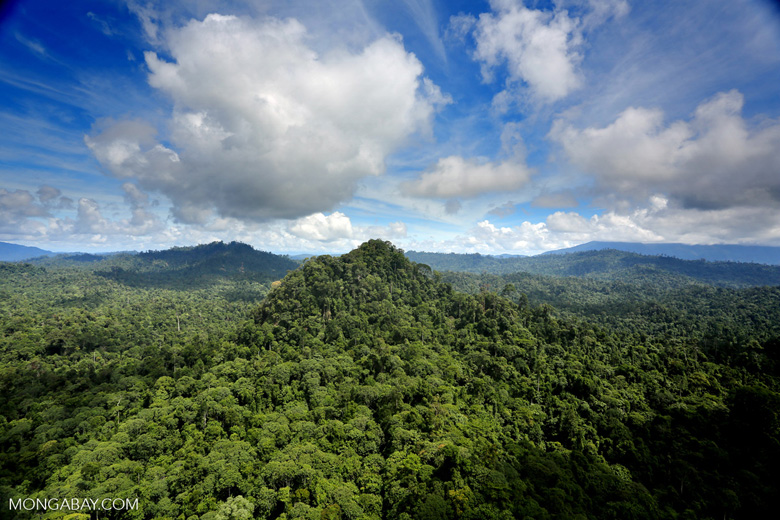
Seventy percent of the world’s remaining rain forests are in five countries: Brazil, Democratic Republic of Congo, Peru, Indonesia and Colombia. Photo by Rhett Butler of mongabay.com
At the close of the UN Climate Summit in December 2018 in Poland, United General Secretary Antonio Guterres was so discouraged by the lackluster outcome that he told world leaders that he would admonish them to increase their urgency and ambition for climate mitigation during Climate Week in New York City (Sept. 23-27, 2019).
Guterres is not alone. Swedish teen Greta Thunberg, in her inimitable way, has inspired millions of school-age children around the world to organize and rally to demand that world leaders treat global warming at the existential crisis that more and more scientists are finding it is.
Add to that an emerging group of faith leaders — the Interfaith Rainforest Iniative (IRI) — that aims to use its moral clout and power in numbers to pressure national leaders to enact policies to slow, reverse and stop deforestation in five tropical countries, as my latest Mongabay story describes.
This kind of religious political lobbying comes with challenges and obstacles, as I explain. But here’s the goal:
“This isn’t about churches planting trees,” said Joe Corcoran, IRI program manager with UNEP, the United Nations Environment Programme. “We want to say clearly and definitively to world leaders: religious leaders take this issue of forests and climate very seriously, and they are going to be holding public officials accountable to make sure these issues are addressed.”
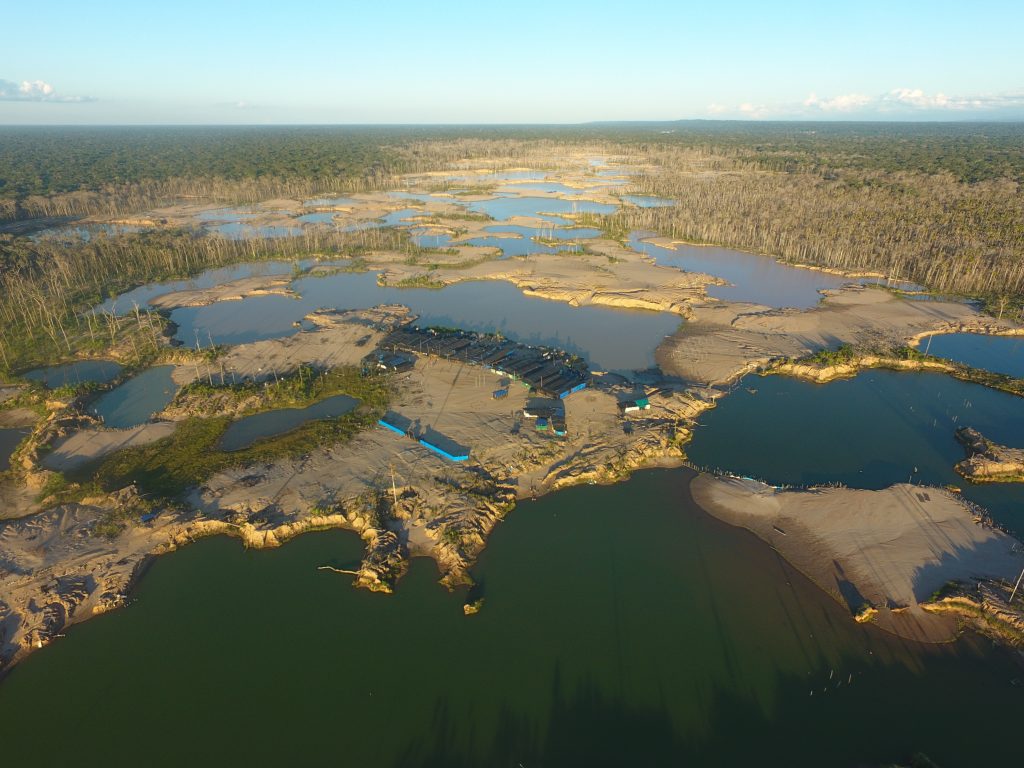
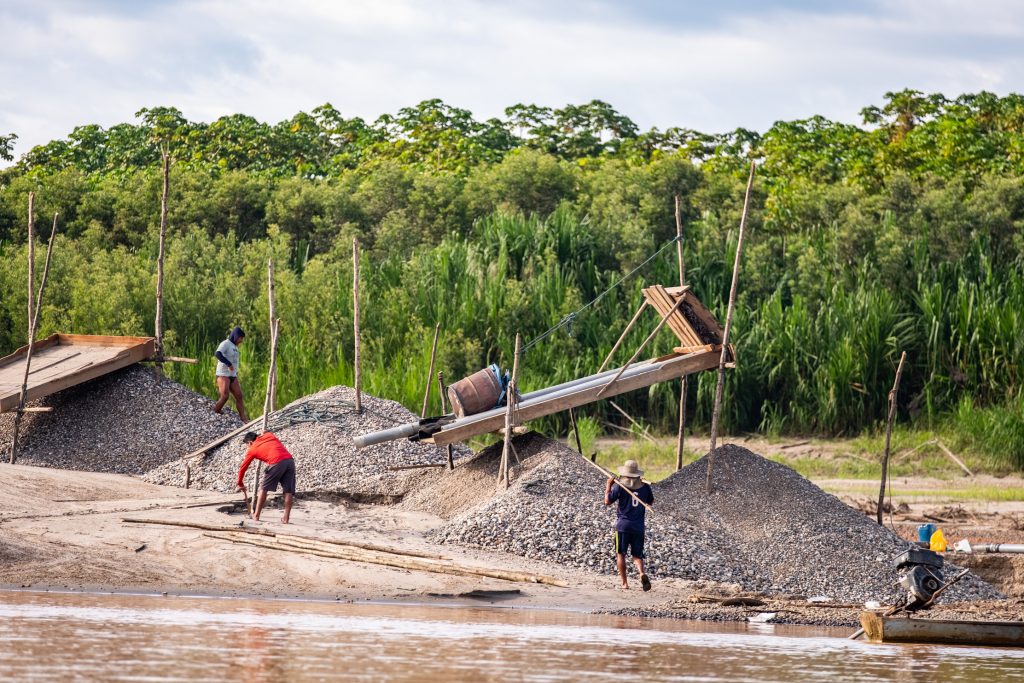
This drone shot of La Pampa in Madre de Dios shows the widespread environmental devastation from alluvial goal mining. A few years ago, that area was entirely dense jungle. In the middle of the photo are military outposts, Peru’s unprecedented attempt to reduce gold mining in one of the most notorious regions for such illegal extraction on earth. Photo by Jorge Caballero Espejo/CINCIA
Because of widespread media attention over the past five years or more — who can resist a story that combines gold, organized crime, prostitution and environmental devastation of a pristine rain forest? — Madre de Dios in the southern Peruvian Amazon has become known worldwide as a kind of hell on earth.
But as my story for Mongbay explains, a lot can happen in a year. La Pampa, the worst but by no means only large-scale illegal mining operation, was raided and largely shut down by the national government in February 2019. And the previous month, Madre de Dios — a region about the size of South Carolina known as the most biodiverse place on earth — elected a governor who wasn’t a miner. Instead, Luis Hidalgo Okimura is intent on reducing mining, formalizing and taxing miners who remain, and rescuing his home region from further environmental destruction.
I got to interview Hidalgo with three of my students in his government conference room not far from our hotel in Puerto Maldonado. After an hour and a half, I knew I had the makings of a good story. Specials thanks to my colleague Cesar Ascorra, national director of CINCIA, for arranging the interview. CINCIA is a Wake Forest-led science project that has developed proven strategies to repair deforested tropical areas and mitigate the public health threat of 185 tons of mercury dumped a year in Madre de Dios.
It was also a pleasure to work again with Mongabay editor Morgan Erikson-Davis. She not only accepted my story pitch, she enhanced the story by both downloading and analyzing satellite images that showed expanding deforestation outside La Pampa.
Riverside alluvial gold mining continues unhindered throughout Madre de Dios, especically along the Rio Inambari and Rio Malinowski. Photo by Jason HoustonThis photo was taken by a member of Gov. Hidalgo’s staff after our 90-minute interview with him. My friend and translator Marianne Van Vlaardingen is on the left, then Wake journalism minor Juliana Marino, me, Hidalgo, Cesar Ascorra, and Wake journalism minors Kat Boulton and Renting Cai.
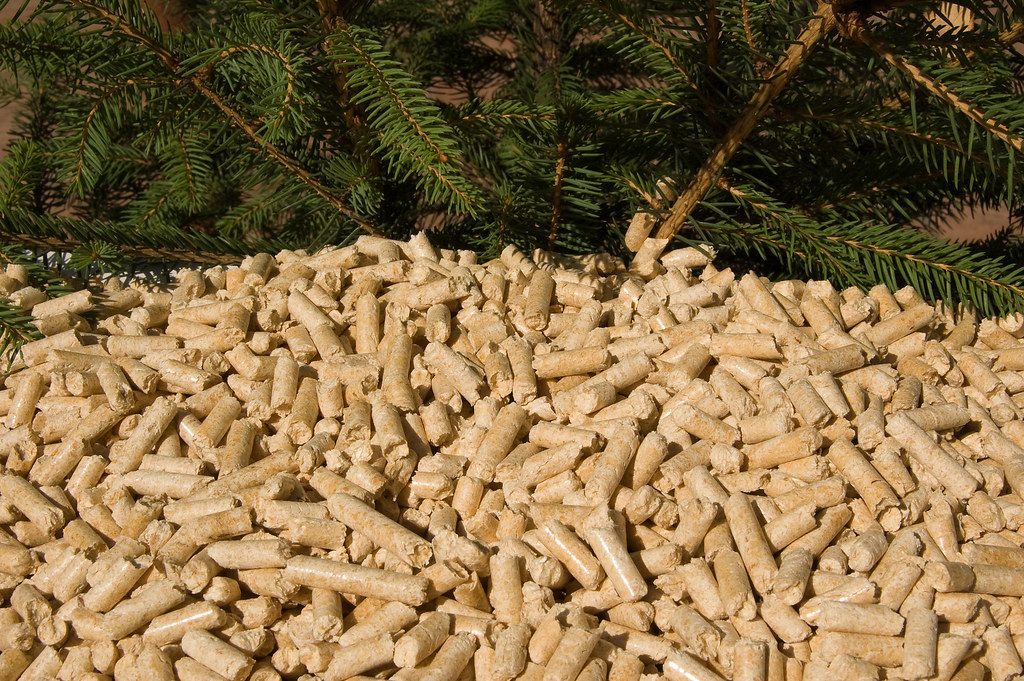
These innocuous looking wood pellets, largely from the US Southeast, are being burned instead of coal in the UK and European Union. And the emissions, which are worse than coal, go uncounted because of an outdated UN policy loophole.
I had been looking for an opportunity to write another story regarding woody biomass and the dubious United Nations policy that allows the accelerating pollution from burning those pellets for energy in the United Kingdom and across the European Union to be ignored in carbon accounting mandates. The opening came in mid-June when the UK announced plans to legislate that it would achieve net-zero carbon emissions by 2050. Many cheered the less-than ambitious goal; if serious greenhouse gas reductions aren’t achieved globally by 2030, the International Panel on Climate Change has warned, nature will not be forgiving as floods, heat waves, drought, sea-level rise, wildfires, ferocious storms, disease and dislocation morph from crisis to calamity.
This story in Mongabay, which my editor Glenn Scherer welcomed and enhanced, explains as clearly and fairly as I can the danger to the planet of implicitly encouraging deforestation to produce wood pellets to be burned for energy with no obligation to report those carbon emissions.
This is an aerial photo of a wood-pellet producing plant located in eastern North Carolina. Those used to be trees that absorbed and stored carbon, harbored animals and birds, and protected the coast against winds, storms, and flooding. They are waiting to become wood pellets to be burned overseas. Photo courtesy The Dogwood Alliance