Author Archives: Justin Catanoso

About Justin Catanoso

Regular contributor to Mongabay since 2015. Professor of Journalism, Wake Forest University since 2011 MA in Liberal Studies, Wake Forest University, 1993 BA in Journalism, Penn State University, 1982

Peru’s first-ever high-resolution carbon map could help the world breathe easier

To put an accurate price on carbon, you need to know how much you have and where it’s located, researchers say. Stanford University scientists have produced the first-ever high-resolution carbon geography of Peru, a country whose tropical forests are among the world’s most vital in terms of mitigating the global impact of climate change. Click here for the whole story at National Geographic NewsWatch.

Photo courtesy Greg Asner

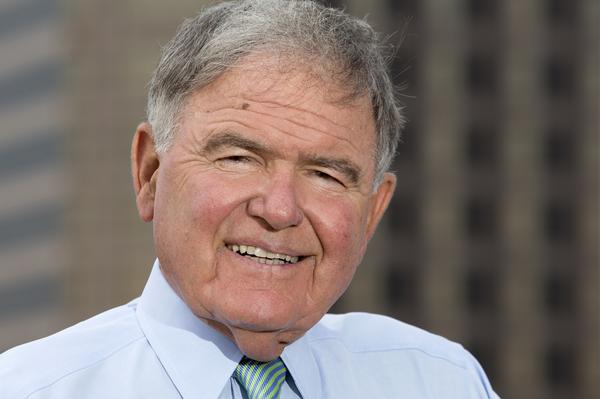
“If not me, who?” At 80, Jim Melvin still building a legacy

Jim Melvin

My first interview with Jim Melvin was in 1988 when I was a young reporter in Winston-Salem for the News & Record of Greensboro. I’ve interviewed him scores of times since. In this most recent interview, he discusses the biggest economic development project he’s ever chased, and — to the delight of advocates and the dismay of critics — makes it clear he has no intention of retiring any time soon.

Excerpt:  Eighty years old. A bronze statue. His name long affixed to City Hall. A list of accomplishments, as well as legions of admirers and critics, that could fill his beloved ballpark. All this might suggest that the end of the road for Melvin as a community leader is in sight.

It’s not. He says he can’t imagine anything worse than getting up in the morning and not having something important to do. He says there is no succession plan at the Joseph M. Bryan Foundation. He says he has no immediate plans to retire.

“Like Mr. Bryan (who retired at 97), I’ll know when it’s time,” he says . Click here for the story.

Photo by Julie Knight

Witnessing a young Pope John Paul II’s passion

While having lunch last spring with good friend David Ford of WFDD, I told him about the time my wife and I — during our honeymoon in 1984 — witnessed the charismatic aura of Pope John Paul II while visiting the Vatican. Ford liked the story so much that we headed straight back to the studio to record it, unscripted. It aired right around the time of the former pope’s canonization. You can hear the recording here.

AOL Travel: Popes John Paul II, John XXIII: A Saint’s Cousin on Being a Pilgrim in St. Peter’s Square for a Canonization

ITALY-VATICAN-CANONIZATION

On the occasion of Pope Francis canonizing two of his beloved predecessors in April 2014, Zach Everson at AOL Travel asked if I would write about story about the spectacle of canonization in Rome from the perspective of someone who had a good reason in 2005 to attend one. I was glad to do it. The story is here.

Excerpt: “On that memorable day, my family and I –- more than 60 of us from America, each of us bursting with pride –- crowded into St. Peter’s Square for what was Benedict’s first canonization ceremony. Rome goes crazy for these events. Stores and restaurants, not to mention buses and cars, are festooned with posters of the saints-to-be. Everywhere we looked in the vicinity of the Vatican, we saw our family name and cousin’s gentle smile. We felt like special guests at a giddy global block party.”

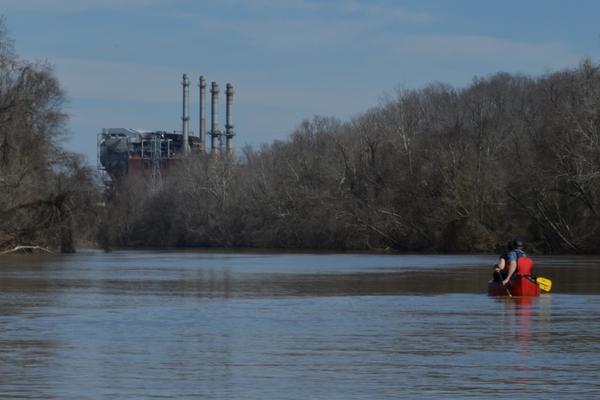
Eden fights to set the record straight on coal ash spill

Dan River behind the spill

The Dan River in Eden, N.C., just above the Duke Energy plant and site of one of the nation’s worst coal-ash spills.

After 39,000 tons of toxic coal ash rom Duke Energy retention ponds spilled into the Dan River just outside Eden, N.C., in early February 2014, the news coverage by local, state and national media was intense. I wrote early on about the environmental impact, too, but saw a larger business story. Two-thirds of the Dan River was unaffected by the spill, yet the communities, and businesses, along that still-clean stretch of the river couldn’t be heard above the outcry over the massive spill. My cover story in the Triad Business Journal explores that angle.

Excerpt: “Add this irony for Eden and a host of Dan River communities west — upstream — of the spill: Their Dan River has no coal ash. It is just as clean and safe as in the days before the massive spill. That simple point has been lost in the great deluge of ongoing media coverage. Eden and Rockingham County have perhaps never gotten so much sustained national attention. Virtually all of it negative. Water, and coal ash, flow downstream. But a toxic perception has flowed in both directions.”

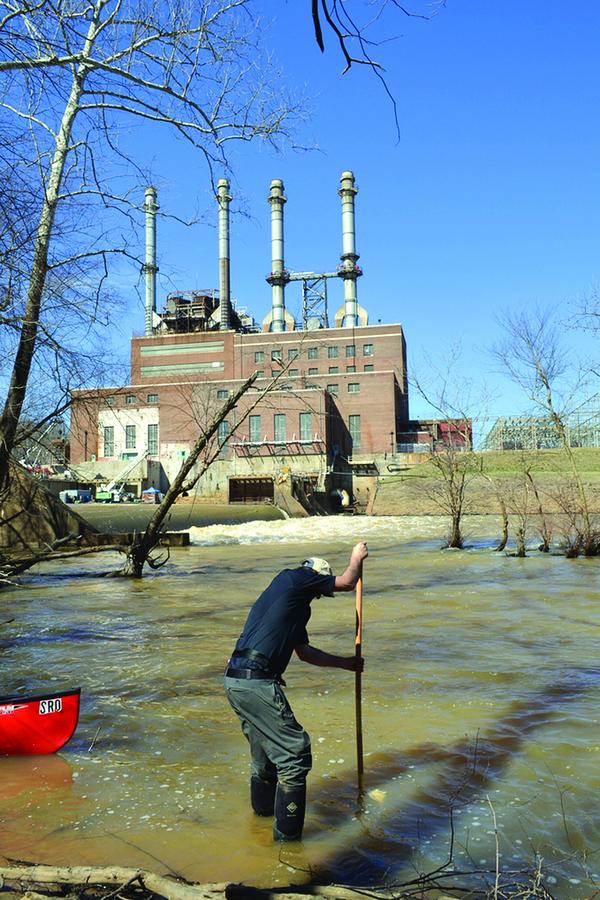
Brian Williams, Dan River Steam plant, coal ash spill, Duke Energy, Eden

Brian Williams, a program manager with the Dan River Basin Association, dredges the river bottom across from the Duke Energy steam plant.

Unlined and Dangerous: Duke Energy’s 32 coal ash ponds in North Carolina pose a threat to groundwater

coal ash spill

Coal ash pulled from the bottom of the Dan River near the site of the Duke Energy spill in Eden, N.C. (Photo courtesy of Dan River Basin Association)

I posted this story to the National Geographic NewsWatch site in March 2014, just a month after the Duke Energy coal-ash spill in Eden, N.C., It made clear early on that coal ash stored in retaining ponds across the state was already threatening ground water in those places. The story caught on through social media and found thousands of readers.

Excerpt: “These coal ash ponds are unlined, and people don’t realize that,” said Dean Naujoks, the Yadkin Riverkeeper who has been monitoring the Dan River spill. “They are continuously leaching arsenic, chromium, cadmium, mercury, all kinds of toxic heavy metals, into the ground and eventually into groundwater. Duke Energy has 32 of these ponds on 14 sites around the state, and every one of them is unlined. Every one of them is a threat to groundwater.”

AOL Travel: Falling in love, Italian style

People in a pizzaria

I wrote this travel story for Zach Everson, a former student of mine at Wake Forest now an editor at AOL Travel. I actually wrote it originally in the summer of 2006 while in Calabria doing research and reporting for my book. It was one of those classic Italian encounters that makes the country so irresistible to travelers — even in the most unexpected places and circumstances.

Falling in “love,” Italian style

By Justin Catanoso   For AOL Travel 

I’m in southern Italy for a month, doing research for my book. One evening, I walk into a pizzeria intent on ordering in Italian, pretending I’m local. The woman behind the counter — early 30s, light brown hair pulled back off a friendly, open face– asks me what I’d like. I scan the glass case and point to a rectangular slice of thick-crusted pizza.

Quello,” I say, that one.

She responds. Uh-oh. I don’t catch a word. So I guess that she’s asked if I’d like it heated. Intent on staying undercover, I say, Si.

She looks at me as if I’ve just teased her, and I’m caught off guard by her lovely, playful smile. She slowly repeats what she said with a touch of attitude. In fact, she’s not asked me a yes or no question. Instead, she asked: are you eating here or taking out? My cover is blown. I close my eyes and shake my head; then I smile back.

At that moment, the looks we exchange are what make Italy so universally beloved by travelers. There is a kindness and playfulness in the simplest of encounters. Her eyes say it all. You’re not from here. You can’t speak Italian. But you’re giving it a shot and you’ve made me laugh. I’m glad you came in. At least, that’s what I read in her eyes — every time she stole a glance at me with another smile.

Now listen, I just talked with my wife long distance and each of m daughters; I’m entirely devoted to them. And yet, I feel like I’m falling in love. Right there in the pizzeria with the woman with the light brown hair. 

I want to lean across the counter and speak Italian like Al Pacino in Godfather III – brooding softly and confidently. I am an American witer here to research the life of a saint, my cousin, of course. Perhaps you’ve heard of him, San Gaetano Catanoso? We should meet later for a glass of wine. I know a great little place on the Corso.

 Naturally, whatever Italian I’ve learned cannot be recalled. I watch silently as she wraps the pizza in paper, tapes the package closed and asks if I’d like a bag (she holds one up, which is how I know what she said). 

Si, I say. At least I remember that.

She smiles one more time, her eyes as lovely as stars, and hands me the package. I resist telling her that I love her. My wife would be proud of me.

 

Climate change policy: Can green replace gold when it comes to REDD?

Tropical forests, like this one in Manu National Park in southern Peru, harbor most of the world’s biodiversity and provide an array of vital ecological services. (Photograph by Justin Catanoso)
I wrote this story for National Geographic NewsWatch following the UN climate change negotiations in Warsaw, Poland, which took place in December 2013. Chris Meyer, a policy expert at the Environmental Defense Fund in Washington, D.C., proved an excellent source. The story focuses on the slow-moving, much-criticized policy called REDD — “reducing emissions from deforestation and forest degradation” — and my best explanation of how it could work (and also why it’s not working yet).

Excerpt: “I think we’re hitting a tipping point with REDD,” Chris Meyer told me. “A lot of countries are committing millions of dollars a year to REDD — the U.K, the United States, Germany, Norway. To invest all this money and then not link it to something bigger in the future, where an international climate structure is built, is very unlikely.”

Video: Climate change’s impact on tropical forests

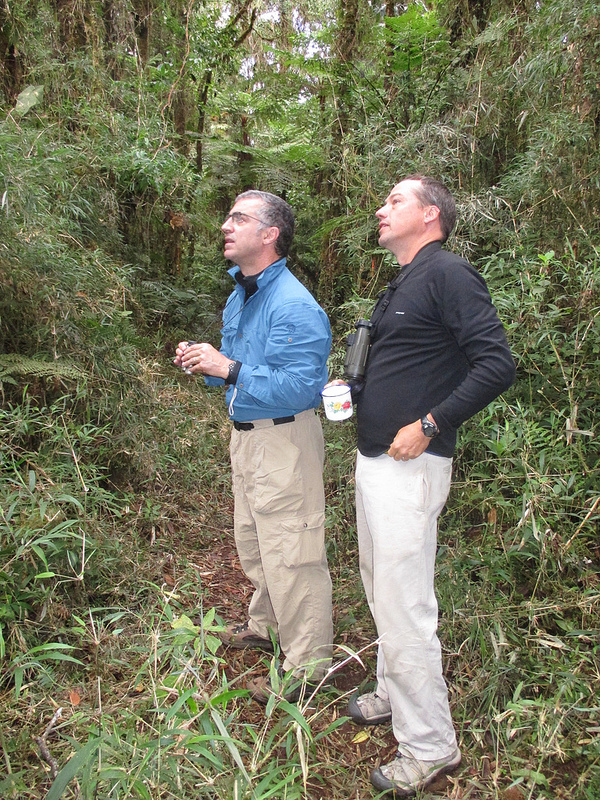
In Peru's Amazon jungle with biologist Miles Silman.

In Peru’s Amazon jungle with biologist Miles Silman. Photo by Ken Feeley.

My reporting on the impact of climate change on tropical forests such as those in Peru’s Amazon Basin was sponsored in part by the Pulitzer Center on Crisis Reporting in Washington, D.C. This invaluable organization makes it possible for freelance foreign correspondents to cover important stories around the world that otherwise would go unreported. Each Pulitzer reporter is asked to produce a Meet the Journalist video that explains his or her project.

My video is here, produced by Meghan Dhaliwal of the Pulitzer Center.

Will Climate Change Imperil Your Cup of Starbucks?

This broad-leafed plant in the rubiaceae, or coffee, family was spotted at 8,000 feet elevation in the Amazon basin of the Peruvian Andes. Such species are not normally seen at such high elevations. Photograph by Justin Catanoso

This broad-leafed plant in the rubiaceae, or coffee, family was spotted at 8,000 feet elevation in the Amazon basin of the Peruvian Andes. Such species are not normally seen at such high elevations. Photograph by Justin Catanoso

I wrote this story for National Geographic NewsWatch following news coverage of a UN report that spelled out how global warming is endangering future food supplies.

Excerpt: “As I learned in my reporting last summer, (2013) in temperate or cold climates, trees and plants are adapted to wide temperature ranges and can migrate to latitudes for many miles north to stay in their ecological comfort zones. In the tropics, where most of the world’s biodiversity exists, trees and plants live in extremely narrow temperature ranges. To survive, they will need to reproduce in higher altitudes where space is far more limited and upslope soils might not be accommodating – hence the possible threat to coffee growing in the future.”